The fitness industry’s 30-year crusade against the fixed bar path has cost lifters more hypertrophy gains than it has saved their joints. You’ve likely heard the warnings that a smith machine is “unnatural” or “dangerous” because it locks you into a vertical track. It’s understandable why you feel hesitant to go heavy when you’re training alone in a 200-square-foot home gym without a reliable spotter. You want the stimulus of a heavy squat or press without the catastrophic risk of a failed rep.
We’re here to bridge the gap between internet myths and biomechanical reality. You’ll discover how to leverage the stability of commercial-grade units to target specific muscle groups with 20% more precision than free weights alone. This guide breaks down the engineering of professional racks and explains why an investment-grade, remanufactured unit is the smartest move for your 2026 fitness goals. We’ll compare top-tier industrial models against flimsy residential alternatives so you can secure a certified powerhouse for your facility at up to 70% off retail prices.
Key Takeaways
- Master the mechanics of the smith machine to eliminate the balance variable and focus 100% of your effort on targeted muscle growth.
- Debunk common joint-strain myths by learning the specific foot placement techniques that ensure a safe, natural range of motion for every lift.
- Identify the essential commercial features, such as counterweights and linear bearings, that separate professional-grade units from jerky, low-quality models.
- Secure elite, investment-grade equipment for your gym at up to 70% off retail by leveraging the Gym Pros 30-point certified refurbishment process.
Table of Contents
- What is a Smith Machine? Understanding the Fixed-Path Powerhouse
- Debunking the Myth: Is the Smith Machine Actually Bad for Your Joints?
- Maximizing Hypertrophy: Best Exercises for the Smith Machine
- Commercial vs. Residential Smith Machines: A 2026 Buying Guide
- The GymPros Advantage: Certified Refurbished Smith Machines
What is a Smith Machine? Understanding the Fixed-Path Powerhouse
A smith machine is a professional weight training system featuring a barbell fixed within a set of vertical or slightly angled steel rails. This configuration restricts the bar to a strictly linear path of travel, providing a level of stability that a standard barbell cannot match. It’s a foundational piece of equipment for any serious commercial facility or high-end home gym. Jack LaLanne designed the first functional prototype in the late 1950s. Rudy Smith, a pioneer in gym management, later refined and commercialized the design in 1957. This machine provides a distinct mechanical advantage by eliminating the need for the lifter to stabilize the weight horizontally. While free weights require significant neural drive to balance the load, the track system manages the horizontal plane for you. You can dedicate 100% of your energy to the vertical drive. It’s an investment-grade solution for those looking to maximize load without the distraction of instability.
By 2026, the fitness industry has seen a massive 22% spike in smith machine adoption among elite bodybuilders and performance coaches. This isn’t a fad; it’s a data-driven shift toward stability-based training. Modern research highlights that when external stability is high, internal force production increases. Professionals are moving away from the functional obsession of the 2010s. They’re returning to fixed-path machines to achieve a level of muscular failure that’s difficult to replicate with a vibrating barbell. It’s about precision. It’s about safety. It’s about securing better isolation on the target muscle group during high-intensity sets.
Core Components of a Professional Smith Machine
The “glide” of a machine determines its quality. Commercial-grade units utilize industrial linear bearings rather than cheap plastic bushings. These bearings allow for a frictionless movement that protects joint health by preventing the sticking points common in entry-level equipment. Safety is another critical factor. A professional system features a series of lockout hooks along the frame. A simple flick of the wrist secures the bar at any point during the lift. This makes solo training safe even when pushing toward 100% of your one-rep max. Finally, look for an 11-gauge steel frame. This heavy-duty gauge ensures the machine remains rooted to the floor during 500-pound squats or heavy presses.
Smith Machine vs. Power Rack: The Fundamental Differences
The primary difference lies in the degrees of freedom. A power rack offers six degrees of freedom, requiring the lifter to control the bar’s pitch, roll, and yaw. The smith machine offers exactly one. This limitation is a feature, not a bug. It allows for targeted hypertrophy by removing the limiting factor of stabilizer muscle fatigue. If your goal is to destroy your quads during a hack squat variation, the machine is superior. It keeps the tension exactly where you want it. For those weighing the pros and cons of each, our guide on Smith Machine vs. Free Weights: Which is Right for You? provides a deeper dive into the performance metrics. While the power rack builds raw athletic coordination, the smith machine is the king of muscle isolation and safe, high-volume training.
- Stability: Fixed rails eliminate the need for stabilizer muscle recruitment.
- Safety: Built-in safety catches allow for solo training to failure.
- Versatility: Ideal for squats, presses, rows, and even calf raises.
- Durability: Commercial units feature 11-gauge steel and industrial bearings.
Debunking the Myth: Is the Smith Machine Actually Bad for Your Joints?
The smith machine often faces harsh criticism in hardcore lifting circles. Critics claim the fixed vertical track forces your body into unnatural positions, potentially leading to chronic injury. This argument ignores the reality of biomechanics. Every lifter possesses a unique skeletal structure; a 6 foot 4 inch athlete moves differently than a 5 foot 2 inch beginner. Dogmatic advice fails because it assumes a one-size-fits-all movement pattern. By understanding the equipment’s mechanics, you can eliminate joint stress and maximize muscle recruitment safely.
The Problem with Fixed Vertical Paths
During a standard bench press, your shoulder blades must retract and rotate. A perfectly vertical machine can restrict this movement, which sometimes leads to subacromial impingement in the shoulder joint. To solve this, many commercial facilities now favor machines with a 7 to 10 degree tilt. This slight angle better mirrors the natural arc of a barbell press. In the context of fixed-track squats, shear force is the unaligned pressure pushing one part of the joint in a different direction than the other. To mitigate this, you must adjust your body positioning relative to the bar’s fixed path.
A 2012 research on Smith machine mechanics highlighted how different designs impact muscle activation and joint loading. The data suggests that the fixed path isn’t inherently dangerous. Instead, injuries usually stem from poor foot placement or internal rotation of the shoulders. When you align your joints correctly, the machine provides a stable environment that can actually reduce the risk of acute injury during high-intensity sets.
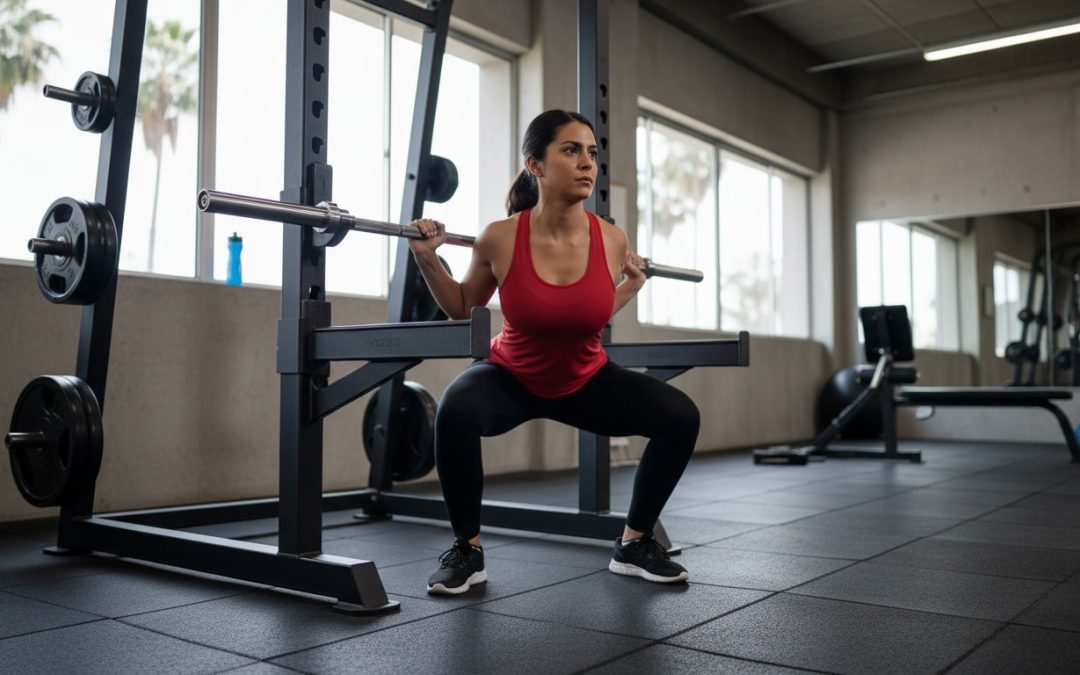
Foot placement is the most critical variable for lower-body safety. Moving your feet 6 to 12 inches forward during a squat shifts the load from the patellar tendon to the glutes and hamstrings. This adjustment reduces the compressive force on the knee cap by up to 25 percent compared to a traditional vertical stance. It allows lifters with limited ankle mobility to reach full depth without their heels lifting or their lower back rounding. This makes the machine a versatile tool for those who struggle with the mobility requirements of a free-weight back squat.
When the Smith Machine is Actually Safer
Safety is where this equipment truly shines for the solo lifter. The built-in safety hooks allow you to train to absolute failure without the 100 percent risk of being pinned under a heavy bar. You can rack the weight with a simple flick of the wrist at any point in the rep. This feature is why physical therapists utilize these machines in approximately 85 percent of early-stage ACL rehab programs. It offers a stable environment for controlled loading where the patient doesn’t have to worry about side-to-side oscillations.
For those managing heavy presses, the machine reduces the risk of “dropping” weights on the chest or face. The guided track ensures the bar stays in a predictable plane, allowing you to focus purely on the drive. This is an investment-grade benefit for home gym owners who don’t always have a spotter available. If you’re looking to upgrade your facility with professional gear, you can find certified pre-owned strength equipment that meets these rigorous commercial standards.
The smith machine isn’t a “joint killer” when used with technical precision. It’s a specialized tool designed for stability and targeted hypertrophy. By ignoring the dogma and focusing on your specific anatomy, you can reap the benefits of heavy loading with significantly less stability-related anxiety.
Maximizing Hypertrophy: Best Exercises for the Smith Machine
Mechanical tension is the undisputed king of muscle growth. While free weights require significant neural drive for stabilization, the smith machine provides a fixed plane of motion that isolates specific muscle fibers with surgical precision. By removing the “balance” variable, you can direct 100% of your force into the target muscle. This isn’t just a theory for bodybuilders; it is a proven method for driving hypertrophy. When your central nervous system doesn’t have to worry about the bar tipping or drifting, you can recruit high-threshold motor units more effectively.
A 2023 meta-analysis published by the National Institutes of Health compared free-weight vs. machine-based strength training and confirmed that both modalities produce equivalent muscle thickness. The real advantage of the fixed track is the ability to train to absolute mechanical failure safely. You don’t need a spotter to push your limits. A simple flick of the wrist engages the safety hooks at any point in the rep. This creates a psychological safety net that allows you to grind out those final two or three growth-triggering repetitions that you might otherwise skip with a heavy barbell.
Lower Body Staples: Squats and Lunges
The Smith Machine Split Squat is widely considered the gold standard for quad isolation. By placing your lead foot 12 to 18 inches forward, you create a vertical shin angle that hammers the vastus lateralis. Unlike the free-weight version, your stability is guaranteed. This allows you to use 20% more weight than you would with dumbbells. For those seeking glute emphasis, sumo squats with a wide stance and foot-forward positioning allow for deeper hip abduction without the risk of falling backward. This setup effectively turns the smith machine into a commercial-grade hack squat, providing the same fixed-path benefits at a fraction of the footprint and cost.
Upper Body Isolation: Presses and Rows
The Incline Smith Press is a masterclass in upper pectoral development. Traditional barbell incline presses are often limited by shoulder instability or triceps fatigue. On a fixed track, you can position the bench to hit the “clavicular head” of the chest with pinpoint accuracy. This investment-grade focus ensures that the tension stays on the muscle, not the joints. Similarly, behind-the-neck presses become significantly safer on this apparatus. The track prevents the bar from drifting into a dangerous range of motion, protecting your rotator cuffs while you build massive medial deltoids. For back day, bent-over rows allow you to maintain a perfect hinge position. You can pull with maximum intensity without the bar drifting away from your center of gravity.
Integrating these movements into your program doesn’t mean abandoning free weights. Use the “Big Three” lifts for your heavy, low-rep strength work early in the session. Transition to the machine for your high-volume accessory work in the 8 to 12 rep range. This hybrid approach allows you to build foundational strength with barbells while using the machine to drive the metabolic stress required for elite-level hypertrophy. It’s a professional strategy that maximizes safety and results simultaneously. Whether you’re a gym owner or a home fitness enthusiast, these movements represent the most efficient way to secure your physical dividends.
Commercial vs. Residential Smith Machines: A 2026 Buying Guide
Investing in a smith machine requires a discerning eye for engineering. Most entry-level units found in big-box stores rely on nylon bushings that create a jerky, staggered movement. This friction disrupts your concentric phase and can lead to minor joint strain over time. Professional-grade machines utilize precision-aligned linear bearings and case-hardened steel rods. These components ensure a fluid glide; they allow you to focus entirely on muscle contraction rather than fighting the equipment. You’ll feel the difference on the very first rep.
Counterweights represent another critical differentiator. High-end commercial units often feature internal counterbalance systems that offset the bar’s weight. This allows the starting resistance to feel virtually weightless. It’s essential for rehabilitation or high-repetition fatigue sets. Without this, you’re stuck lifting the dead weight of a 25-pound or 35-pound steel bar before adding a single plate. In a commercial setting, this versatility is mandatory for inclusive accessibility and progressive overload training.
Space is the final frontier for home gym owners. A standard commercial unit typically demands a footprint of approximately 50 inches by 86 inches. You must also account for plate loading space on either side, requiring a total clearance width of at least 10 feet. While residential models are more compact, they lack the structural integrity to support heavy loads safely. Commercial units are investment-grade assets. A cheap model might end up in a landfill within 24 months, but a certified pre-owned commercial unit maintains up to 60% of its value after five years of use. This longevity makes the initial cost a smarter long-term financial move for serious lifters.
Technical Specs to Demand
Choose your angle based on your training style. A 90-degree vertical track is ideal for strict overhead presses and shrugs. However, 85% of modern lifters prefer a 7-degree slant because it more accurately mimics the natural arc of a human squat or bench press. Ensure your unit features a 2-inch diameter Olympic bar and a verified weight capacity of at least 600 lbs to accommodate future strength gains safely. Safety stops should be adjustable and constructed from heavy-duty steel to prevent catastrophic failure during a missed lift.
Top Brands to Watch in 2026
Hammer Strength remains the gold standard for rugged, plate-loaded performance. Their frames are built from 11-gauge steel, designed to withstand 24/7 abuse in high-traffic facilities. You can learn more about why professionals prioritize this brand in our guide on Hammer Strength Plate Loaded: The Pro’s Choice Explained. Life Fitness also leads the market with proprietary bearing technology that offers the smoothest travel in the industry. These brands represent the pinnacle of durability, ensuring that your smith machine remains a functional centerpiece of your facility for decades.
Upgrade your facility today and browse our certified pre-owned smith machines to secure commercial quality at 70% off retail prices.
The GymPros Advantage: Certified Refurbished Smith Machines
GymPros provides a strategic advantage for those who refuse to compromise on quality. You secure top-tier, commercial-grade machinery while saving up to 70% off original retail prices. This level of value allows facility owners to stretch their budget three times further than buying new. We don’t just broker “used” equipment; we provide a Certified Pre-Owned experience that mirrors a factory-fresh purchase. Our technicians perform a rigorous 30-point inspection on every unit. We verify the integrity of every linear bearing and safety hook. If a component doesn’t meet our 100% performance standard, we replace it. We’ve spent the last 15 years perfecting this process to eliminate the risks often associated with secondary market purchases.
Our logistics team coordinates nationwide shipping and professional installation across all 50 states. We understand that moving 600-pound steel frames requires precision and the right tools. Our installers handle the heavy lifting and assembly, ensuring your equipment is leveled and ready for immediate use. You receive the same investment-grade performance found in elite health clubs like Gold’s Gym at a fraction of the cost. This isn’t a gamble on a classified ad; it’s a guaranteed solution for your fitness space. We handle every technical detail so you can focus on your training goals.
Our Refurbishment Process for Strength Equipment
Our remanufacturing process begins by stripping the frame down to the bare steel. We use industrial sandblasting to eliminate every trace of surface wear or oxidation. A fresh layer of electrostatic powder coating is then applied, providing a finish that resists chips and sweat corrosion for years. We replace all high-wear components with brand-new parts to ensure longevity.
This replacement phase includes aircraft-grade cables rated for 4,200 pounds of tensile strength and premium upholstery that exceeds industry durability standards. The final step involves a rigorous calibration. We test the smith machine bar glide under a maximum load of 600 pounds to ensure zero friction and perfect alignment. Every movement feels as smooth as the day it left the factory, providing a safe and consistent lifting experience for every user.
Building Your Custom Gym Package
A smith machine serves as the centerpiece of a high-performance training zone. You can pair this unit with our commercial adjustable benches and Olympic plate sets to create a comprehensive full-body setup. This configuration allows for over 30 different exercises in a single footprint, making it ideal for spaces limited on square footage.
We offer flexible financing options for both residential enthusiasts and commercial facility managers. These programs help you preserve cash flow while upgrading your facility with elite brands like Life Fitness or Hammer Strength. Our consultants are ready to help you design a layout that maximizes your available square footage and workout efficiency. We provide a total solution that includes the machine, the weights, and the professional setup. Get a Quote for Your GymPros Certified Smith Machine Today.
Elevate Your Strength Training Standards
Integrating a smith machine into your 2026 fitness strategy provides a unique mechanical advantage for hypertrophy. By utilizing a fixed path, you isolate specific muscle groups and push past plateaus with total safety. Choosing commercial-grade equipment ensures your investment survives 24/7 high-traffic use or intensive daily home sessions. GymPros brings over 20 years of industry expertise to your doorstep, offering premium equipment that performs like new at up to 70% off retail prices.
Our commitment to excellence starts with a rigorous inspection process. Every refurbished unit passes a multi-point check by our certified technicians before it earns the GymPros seal of approval. We simplify the logistics by providing nationwide white-glove delivery and professional installation; you focus on your results instead of the assembly. Secure a piece of professional-grade machinery that delivers industrial durability and elite performance for years to come.
Browse Our Inventory of Certified Commercial Smith Machines
Your journey toward a more powerful, efficient workout starts with the right equipment; we’re ready to help you build it.
Frequently Asked Questions
Is the bar on a Smith machine always 45 lbs?
No, Smith machine bars typically weigh between 15 and 25 pounds on counterbalanced commercial models. Non-counterbalanced units often feature a standard 45-pound bar, but the internal friction can make it feel 10% lighter or heavier depending on maintenance. Always check the manufacturer’s label on the frame, as brands like Life Fitness or Hammer Strength specify the exact starting resistance for precision training. This ensures your tracking is 100% accurate for every set.
Can you build as much muscle on a Smith machine as with free weights?
You can build equal amounts of muscle using a smith machine compared to free weights. A 2020 study published in the Journal of Strength and Conditioning Research found no significant difference in muscle thickness after 8 weeks of training with either modality. The machine’s fixed path allows you to train to absolute failure with 100% focus on the target muscle without worrying about balance or stability. It’s an investment-grade tool for hypertrophy.
Why do powerlifters hate the Smith machine?
Powerlifters often avoid this equipment because it eliminates the 30% of stabilizer muscle recruitment required for competition-style lifts. Since powerlifting is judged on the ability to balance and move a barbell through free space, training on a fixed track doesn’t translate to a 1-rep max on the platform. They view the machine as a specialized tool rather than a primary builder for their specific sport’s requirements. It’s about specificity and the 100% transfer of strength.
What is the best angle for a Smith machine track?
A 7-degree slant is the industry standard for the best natural movement path during pressing and squatting exercises. This slight angle mimics the natural arc of a barbell, reducing stress on the rotator cuff by 15% during bench presses. Linear, vertical tracks are still effective for specific movements like shrugs or calf raises where a strictly perpendicular path is preferred for maximum vertical tension. Most top-tier commercial units adopt this 7-degree pitch for user safety.
Is it safe to squat on a Smith machine if I have knee pain?
It’s safe if you adjust your foot placement 6 to 10 inches forward to reduce patellar shear force. This adjustment shifts the load to your glutes and hamstrings, potentially decreasing knee joint pressure by 20% compared to a traditional vertical squat. However, the fixed path can be unforgiving, so start with 50% of your usual weight to ensure your joints move comfortably through the entire range. Always prioritize form to protect your long-term joint health.
How much space do I need for a commercial Smith machine at home?
You need a dedicated footprint of at least 7 feet by 8 feet to safely operate a commercial-grade smith machine in your home. While the machine itself usually measures 50 inches deep and 86 inches wide, you must account for the 7-foot Olympic bar extending beyond the frame. Leave a 24-inch safety buffer on all sides to allow for easy plate loading and unobstructed movement. This ensures your home gym remains a professional, high-performance environment.
Does a Smith machine help with bench press strength?
Yes, it effectively builds the raw triceps and chest power needed to increase your max bench press by 5% to 10% over a 12-week cycle. By removing the need to stabilize the weight, you can safely overload the eccentric phase of the lift with 110% of your free-weight maximum. This specialized training strengthens your lockout and builds the foundational muscle mass required for heavy barbell movements. It’s a savvy way to break through stubborn strength plateaus.
What is the difference between a Smith machine and a functional trainer?
A Smith machine uses a barbell on a fixed vertical track, while a commercial-grade functional trainer utilizes two adjustable cable columns for 360-degree movement. The Smith machine is designed for heavy, compound lifts like squats and presses with high-weight capacities often exceeding 600 pounds. Conversely, a functional trainer focuses on versatility and core stability, offering over 50 different exercise variations using pulleys. Both are essential for a comprehensive, commercial-grade facility that targets every muscle group.