That $600 “bargain” elliptical machine from a big-box retailer is actually the most expensive mistake you’ll make this year when it starts squeaking by month four. You’re likely tired of equipment that shakes during high-intensity intervals or causes nagging hip pain due to poor ergonomics. It’s frustrating to realize that 85% of residential-grade machines are built with plastic bushings rather than the sealed steel bearings found in professional clubs.
You deserve a workout that feels as smooth on day 3,000 as it did on day one. By choosing commercial-grade technology, you’re investing in industrial durability and biomechanics designed to protect your joints for over 10 years of daily use. We’ll show you how to cut through the marketing jargon to find investment-grade equipment. This guide breaks down the 2026 standards for drive systems and explains how securing a remanufactured unit allows you to bring a $5,000 machine home for a fraction of the retail cost.
Key Takeaways
- Learn how to calculate the true ROI of your fitness investment by comparing the long-term durability of commercial-grade units against standard residential models.
- Master the technical specifications that define a high-performance elliptical machine, including the impact of heavy-gauge steel and flywheel inertia on workout smoothness.
- Avoid common installation pitfalls by using our expert framework to measure for critical spatial requirements like ceiling height and peak incline “step-up” distance.
- Discover how to secure investment-grade equipment at a fraction of the cost through the rigorous Gym Pros 30-point certification and remanufacturing process.
- Identify the core biomechanical differences that allow commercial units to handle heavy daily duty cycles while maintaining superior, low-impact joint protection.
What is an Elliptical Machine? Beyond the Basic Definition
An elliptical machine is a stationary exercise unit designed to simulate stair climbing, walking, or running while eliminating the jarring impact of traditional pavement training. By 2026, the demand for low-impact conditioning has surged by 22% as users prioritize joint longevity over high-intensity impact. This equipment utilizes a weighted flywheel connected to foot pedals through a complex series of linkages. This core mechanism creates a fluid, egg-shaped path that matches your body’s natural stride. Investing in a high-quality What is an elliptical trainer involves understanding that the machine provides a total-body workout by engaging the upper and lower muscle groups simultaneously without the orthopedic stress found in running.
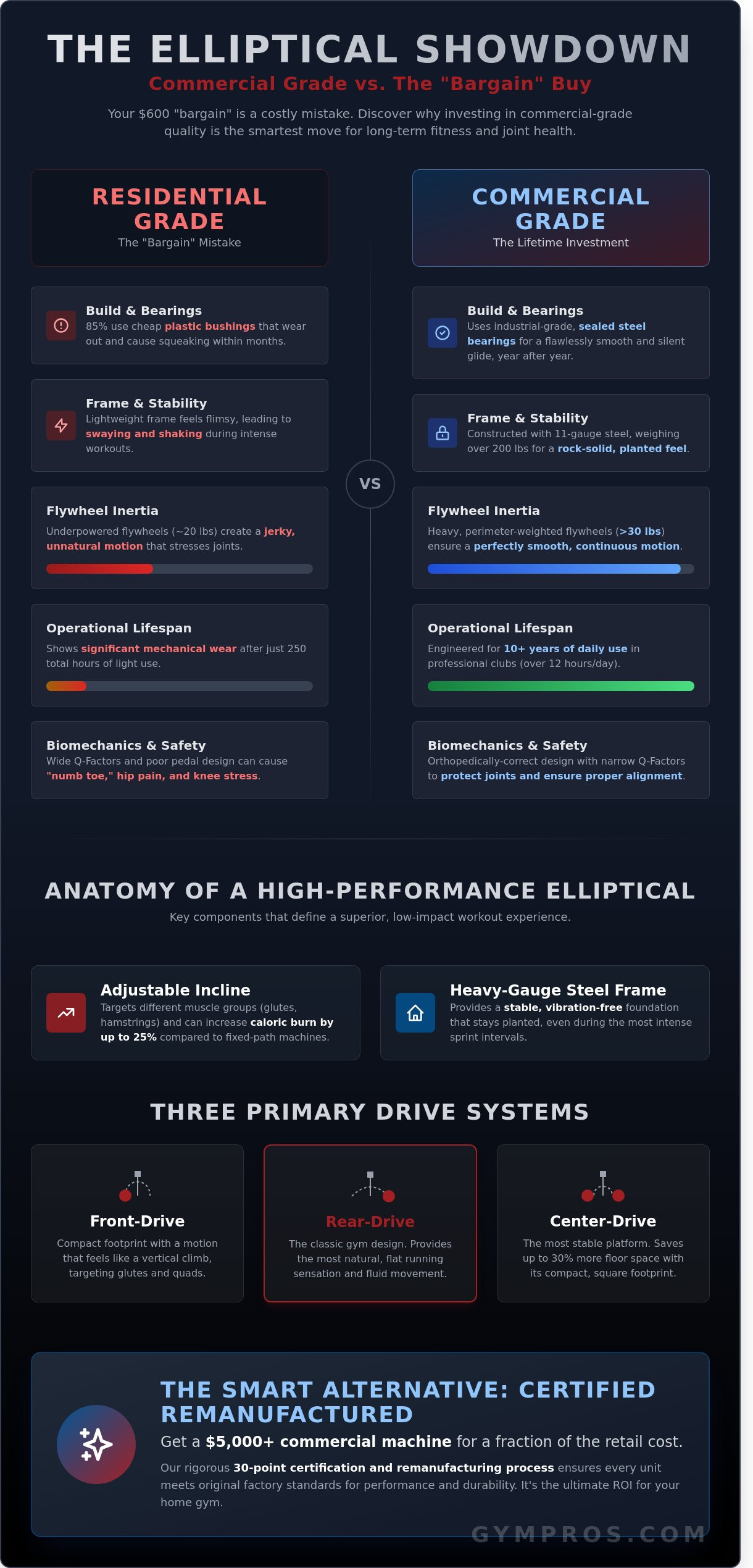
The distinction between commercial and residential equipment is where most buyers make a critical error. A standard residential unit often features plastic bushings and a 20-pound flywheel; these are designed for light use. In contrast, a commercial-grade elliptical machine uses sealed ball bearings and flywheels exceeding 30 pounds. These industrial machines are built for 12 hours of daily operation. Home-grade models often show significant mechanical wear after just 250 total hours of use. Buying a certified pre-owned commercial unit allows you to secure this investment-grade durability at a fraction of the cost.
The Three Primary Types of Elliptical Drives
- Front-drive ellipticals: These units place the drive housing at the front. They offer a compact footprint, often measuring under 70 inches in length. The motion feels more like a vertical climb, which targets the glutes and quads aggressively.
- Rear-drive ellipticals: This is the classic gym design. The drive system sits behind the user, creating a long, flat elliptical path. It provides the most natural running sensation and remains the gold standard for fluid movement.
- Center-drive ellipticals: These machines place the flywheels on either side of the user. They are the most stable units on the market. Their square footprint saves up to 30% more floor space than traditional rear-drive models.
Why Biomechanics Trump Features
Flashy touchscreens don’t burn calories; proper alignment does. Poorly designed pedals cause “numb toe” by forcing the foot into a constant downward tilt. This position cuts off circulation and leads to premature fatigue. Q-Factor is the horizontal distance between the pedals and impacts knee safety by ensuring your hips and ankles remain perfectly aligned. When this distance is too wide, it creates lateral stress on the knee joint. Commercial units from brands like Precor or Life Fitness prioritize these orthopedic metrics over entertainment consoles. They use adjustable pedal angles and narrow Q-Factors to prevent hip misalignment. Choosing a machine with superior biomechanics ensures your 20-minute workout is effective rather than injurious. Professional-grade equipment is engineered to support the body’s natural gait, making it the savvy choice for serious fitness enthusiasts.
The Anatomy of a High-Performance Elliptical
Frame construction is the foundation of any commercial-grade elliptical machine. You should prioritize units built with 11-gauge, heavy-gauge steel. This material choice isn’t just for show; it provides the structural integrity needed to eliminate the side-to-side sway found in lighter, retail models. A machine weighing over 200 pounds creates a rock-solid base that stays planted during high-intensity intervals. If a unit feels flimsy on the showroom floor, it will likely vibrate and shift once you reach peak resistance in your home gym.
Flywheel weight dictates the quality of your workout motion. A 25-pound or 30-pound perimeter-weighted flywheel uses inertia to create a smooth, consistent loop. This weight is vital because it carries your legs through the “dead spots” at the top and bottom of the rotation. Without sufficient flywheel mass, the movement feels jerky, which puts unnecessary stress on your knee and ankle joints. High-inertia systems also allow for seamless resistance transitions, ensuring the machine reacts instantly when you adjust your intensity level.
Adjustable incline is a powerful feature for targeted muscle recruitment. Moving beyond a flat path allows you to shift the workload between different muscle groups. A 15% to 20% incline grade significantly increases activation in the glutes and hamstrings, while lower settings focus on the quadriceps and calves. This versatility can increase your caloric burn by 25% compared to training on a fixed-path machine. It also helps prevent training plateaus by constantly challenging your body with new angles of resistance.
The longevity of your investment depends on the quality of its internal components. Professional units utilize sealed commercial ball bearings at every pivot point. These components are engineered for 12 hours of daily use in high-traffic health clubs. They outlast the cheap plastic bushings found in budget equipment by at least 10 years. While bushings often begin to squeak or degrade after 18 months of regular use, sealed bearings remain silent and fluid for the life of the machine. Selecting a certified pre-owned model allows you to access this commercial-grade anatomy without the typical retail price tag.
Stride Length: The Secret to a Natural Feel
The 18 to 20 inch stride length is the “Goldilocks” zone for 95% of adult users. It mimics a natural running gait without overextending the hips. Budget machines often feature short strides under 16 inches, which creates a cramped, “stepping in a bucket” sensation for anyone over 5 feet 8 inches tall. Premium units, such as the Precor EFX series, often include adjustable or motorized stride features to accommodate multiple users in a single household perfectly.
Upper Body Integration
Moving handlebars offer a total-body workout, but the handle path must be ergonomically correct to prevent shoulder strain. Look for multi-grip designs that allow for neutral, wide, and narrow hand positioning. This variety lets you engage the lats, chest, and triceps more effectively. Ensure the machine includes fixed handlebars as well; these are essential for stability when you want to focus exclusively on lower-body power during high-incline intervals or sprint sessions.
Commercial vs. Residential: Calculating the Real ROI
Savvy investors know that the sticker price is only one part of the equation. When you buy an elliptical machine, you are choosing between a short-term expense and a long-term asset. A typical $1,000 residential unit is engineered for a lifespan of roughly 24 to 36 months under light use. In contrast, a $3,500 certified pre-owned commercial unit is built to perform for 15 to 20 years. When you break this down into a “Price per Workout” metric, the commercial machine costs approximately $233 per year of ownership, while the “budget” option costs you $500 per year because of its frequent replacement cycle.
The difference lies in the duty cycle. Residential machines are designed for a maximum of 5 hours of use per week. If a family of four uses the machine daily, the motor and bushings will likely fail within the first year. Commercial units are the workhorses of the fitness world. They are engineered to handle 12 to 18 hours of continuous operation every single day. This industrial-grade durability ensures that a home user will likely never reach the mechanical limits of the machine.
Repairability is another factor that separates professional equipment from “disposable” retail models. Legacy commercial brands maintain massive inventories of replacement parts for decades. If a 15-year-old Precor needs a new drive belt, you can source it easily. If a “no-name” brand from a big-box retailer breaks, the manufacturer has often disappeared or discontinued the parts. This makes the machine impossible to fix. Furthermore, the resale market for premium brands remains liquid. A used Life Fitness or Matrix machine often retains 40 percent of its original value after a decade, whereas residential models often have zero resale value after three years.
The Hidden Cost of ‘Smart’ Home Ellipticals
Modern marketing often pushes integrated touchscreens and “connected” fitness. These features carry a heavy financial tail. Mandatory subscriptions like iFit or Peloton cost between $39 and $44 per month. Over five years, you will spend an additional $2,340 to $2,640 just to keep the screen active. There is also a significant risk of “bricking.” If the manufacturer stops supporting the tablet software or the company goes bankrupt, your machine loses its primary functionality. Pro-grade LED consoles are the gold standard for reliability. They provide all necessary data without the subscription tax or the risk of software obsolescence.
Weight Capacity and Stability
Structural integrity is best measured by user weight capacity. A machine rated for 400 lbs is not just for larger users; it indicates the use of 11-gauge steel and heavy-duty pivot points. Brands like Hoist Fitness build their equipment to exceed these standards, ensuring a rock-solid foundation. You can test this with the “Wobble Test.” High-quality commercial units stay planted during high-intensity intervals and do not require thick rubber floor mats to prevent them from walking across the room. This stability protects your joints by ensuring the elliptical path remains true even under maximum resistance levels.
The Gym Pros Selection Framework: How to Choose
Selecting a commercial-grade elliptical machine requires more than just checking a price tag. You need a systematic strategy that accounts for physical constraints and long-term performance. Our framework prioritizes durability and user safety to ensure your investment-grade equipment stands the test of time.
Step 1: Measure your ceiling height. This is the most common mistake home gym owners make. You must calculate your total vertical footprint by adding the user’s height to the machine’s maximum “step-up” height. Most commercial units have a pedal height of 10 to 16 inches at peak incline. Add another 6 inches for the natural “bounce” of a runner. If you are 6 feet tall and the machine has a 14-inch step-up, you need at least an 8.5-foot ceiling to operate safely.
Step 2: Identify your primary goal. Every machine is engineered for a specific outcome. If your focus is weight loss, look for units with high-resistance intervals. For athletic performance, prioritize machines with adjustable stride lengths. If you’re focusing on rehab, seek out models with low starting resistance and specialized handrails. Choosing the wrong tool for the job leads to plateauing results and unused equipment.
Step 3: Determine your budget. New commercial units often retail between $5,000 and $10,000. You don’t have to pay those prices to get that quality. The “Certified Refurbished” advantage allows you to secure top-tier brands like Life Fitness or Precor at up to 70% off retail. This approach lets you own a rugged, industrial-grade machine for the price of a flimsy “big box” store model.
Step 4: Verify the warranty. A warranty is a manufacturer’s promise of quality. In the secondary market, the warranty is your ultimate trust signal. Ensure your purchase includes comprehensive parts and labor coverage. At GymPros, we provide a structured warranty because we believe in our rigorous 29-point inspection process. Never settle for a “sold as-is” unit when buying high-ticket fitness equipment.
Matching Brands to Your Training Style
Precor is the industry pioneer, famous for the patented CrossRamp technology that adjusts stride angles between 13 and 40 degrees. Life Fitness is the gold standard for durability; their units are built to withstand 20 hours of daily use in commercial clubs. Cybex offers the “Arc Trainer” path, which uses a unique curvilinear motion. Studies show the Arc Trainer burns 16% more calories than standard models while maintaining zero joint impact. For those seeking the ultimate in biomechanical innovation, Cybex Arc Trainers deliver a three-in-one solution that combines the benefits of a glide, stride, and climb in a single machine.
Space Planning for Your Home Gym
Safety requires a 24-inch clearance zone on all sides of the elliptical machine. This “Safety Zone” prevents accidents during mounting and provides technicians enough room for maintenance. Power requirements are equally critical. Most commercial-grade motors require a dedicated 120V circuit to prevent tripped breakers during high-intensity sessions. Finally, protect your subfloor. Use 8mm thick recycled rubber matting rather than soft foam; high-density rubber prevents the machine from “walking” or vibrating during use. If you’re considering multiple pieces of cardio equipment for your home gym, our commercial-grade exercise bike buying guide provides the same rigorous selection framework to help you choose between upright and recumbent styles.
Ready to secure a commercial-grade unit for your home? Browse our certified pre-owned elliptical inventory and save thousands today.
The Smart Alternative: Why Certified Refurbished Wins
Buying a high-end elliptical machine doesn’t require a five-figure investment. Many shoppers confuse “used” with “certified refurbished.” Used equipment is typically sold as-is, often carrying the hidden wear and tear of a high-traffic health club. Gym Pros Certified Refurbished units are remanufactured to like-new standards. We strip each unit down to its core frame and rebuild it from the ground up. This rigorous process allows you to secure premium commercial quality for up to 70% less than the original MSRP.
Our 30-point inspection protocol is the industry benchmark. We don’t just wipe down the frame and call it a day. Our technicians meticulously adjust belt tension, lubricate every sealed bearing, and recalibrate drive motors to original factory specifications. This technical rigor ensures the machine performs exactly as it did the day it left the assembly line. You get the same fluid motion and structural integrity that professional athletes expect.
Choosing refurbished gym equipment is also a powerful environmental statement. By 2026, the global fitness industry aims to reduce its carbon footprint by 25%. Refurbishing 400 pounds of commercial-grade steel prevents massive amounts of industrial waste and saves the energy required to forge new metal. It’s the greener choice for the modern home gym owner who values sustainability as much as performance.
We eliminate the logistics headache by providing a total solution. Your purchase integrates freight shipping, professional white-glove installation, and robust extended warranties into one seamless transaction. You’re not just buying a piece of equipment; you’re securing a complete service package that guarantees your machine is ready for use the moment it enters your home.
Our Master Technicians’ Process
The journey begins with a complete teardown where we replace every wear-item regardless of its current state. This includes drive belts, bushings, and console overlays to ensure the interface feels crisp and responsive. To ensure the electronics and heart-rate sensors function at 100% accuracy, we test them against medical-grade pulse oximeters. Every single unit undergoes a final 30-minute diagnostic load-test where a technician monitors for heat spikes, vibration, and noise at maximum resistance levels.
Securing Your Investment
Standard manufacturer warranties often limit coverage to 90 days for labor on pre-owned units. The Gym Pros warranty program shatters that standard, providing comprehensive protection that rivals new equipment coverage. We maintain a nationwide service network of 500+ certified technicians ready to assist. If your elliptical machine needs attention, we dispatch help directly to your door, supporting your machine long after the delivery truck leaves your driveway.
Ready to upgrade your home gym? Browse our current inventory of Certified Refurbished Commercial Ellipticals.
Invest in Your Long-Term Performance Today
Choosing a commercial-grade elliptical machine means you’re prioritizing durability and biomechanical precision over temporary convenience. Residential units often fail within 24 months of heavy use, but industrial-strength equipment is engineered to last a decade or longer. By opting for a certified refurbished model, you’re securing this elite performance at a fraction of the standard $5,000 retail price point.
GymPros has built a reputation for excellence, maintaining an A+ BBB Rating since 2003. Our technicians execute a rigorous 30-Point Certified Refurbishment Process on every piece of equipment to guarantee it operates like new. We don’t just ship boxes; we provide a total solution with nationwide white-glove delivery and professional installation. You’re getting more than a machine; you’re getting a commitment to your health backed by over twenty years of industry expertise. Stop settling for flimsy retail alternatives and bring the quality of a professional health club into your own home.
Shop Gym Pros Certified Commercial Ellipticals & Save Up to 70%
Your future self will thank you for choosing quality that lasts.
Frequently Asked Questions
Is an elliptical better than a treadmill for weight loss?
An elliptical machine provides a comparable calorie burn to a treadmill while reducing joint impact by 40% according to biomechanical studies. A 185 pound individual burns approximately 335 calories in 30 minutes on an elliptical, matching the output of a 5 mph run. You’ll sustain higher intensity workouts for longer periods because the perceived exertion is lower. This makes it a superior long term investment for consistent weight loss without the risk of stress fractures.
How much should I realistically spend on a good elliptical machine in 2026?
Expect to invest between $1,500 and $3,500 for a high performance elliptical machine in 2026. While entry level retail models start at $600, they often fail within 24 months of heavy use. Choosing a GymPros certified remanufactured unit allows you to secure a $7,000 commercial grade model for roughly $2,100. This represents a 70% saving on equipment designed to handle 12 hours of daily operation.
Do elliptical machines help lose belly fat?
Elliptical machines facilitate belly fat loss by creating the necessary systemic caloric deficit. You can’t spot reduce fat, but burning 500 calories per session helps shed visceral fat over a 12 week period. Engaging the moving handlebars increases total energy expenditure by 15% compared to lower body only exercise. This full body engagement accelerates your metabolic rate, ensuring you burn more fuel both during and after your workout.
What is the difference between an elliptical and a cross trainer?
The primary difference lies in the upper body engagement. A standard elliptical features stationary handles, while a cross trainer includes moving arms for a total body workout. Using a cross trainer increases muscle activation in the upper body by 15%, targeting the back, shoulders, and arms. Most modern commercial units are technically cross trainers. They offer a more efficient path to fitness by taxing multiple muscle groups simultaneously.
Can I fit a commercial elliptical in a room with 8-foot ceilings?
You can fit most commercial models in a room with 8 foot ceilings if the machine’s max pedal height is under 20 inches. A 6 foot tall user needs at least 12 inches of clearance above their head at the highest point of the stride. Always add your height to the machine’s 15 inch step up height before purchasing. If your total height exceeds 90 inches, you’ll risk hitting the ceiling during high incline intervals.
How long does a refurbished commercial elliptical typically last?
A GymPros certified remanufactured elliptical typically lasts 10 to 15 years with basic maintenance. These machines are engineered for 10,000 plus hours of use in high traffic health clubs. Our 30 point inspection and parts replacement process ensures the electronics and drive system perform like new. You’re buying a rugged, industrial grade frame that vastly outlasts the 3 year lifespan of typical residential grade equipment.
Is it worth paying for professional installation for an elliptical?
Professional installation is highly recommended because commercial units weigh between 200 and 400 pounds. Proper assembly prevents frame misalignment and ensures the drive belt is tensioned to factory specifications. This 2 hour service protects your investment and prevents the 15% of mechanical failures caused by improper DIY setup. It also guarantees your warranty remains valid. We handle the heavy lifting so you can start training immediately with total confidence.