The StairMaster is the only piece of equipment that delivers a 400-calorie burn in a single 30-minute session while simultaneously building functional lean muscle mass. You’ve likely hit that frustrating weight loss plateau or felt the nagging knee pain that follows a five-mile run on concrete. It’s exhausting to spend an hour on a treadmill only to feel like your progress has stalled and your joints are paying the price. Understanding the specific stairmaster benefits is the first step toward reclaiming your time and achieving a low-impact, high-intensity transformation that lasts.
You’re about to discover why investing in commercial-grade equipment is the smartest move for your 2026 fitness goals. We will break down the science-backed physiological advantages that turn a simple climb into a powerhouse for your glutes and cardiovascular system. This guide explores the mechanical superiority of the StepMill and explains how Gym Pros certified pre-owned units provide top-tier durability at a fraction of the retail cost. Get ready to transform your home gym with an investment-grade machine built for performance and longevity.
Key Takeaways
- Understand the “gravity advantage” and why a revolving StepMill provides a superior workout compared to traditional pedal-based steppers.
- Discover the science-backed stairmaster benefits that allow for higher metabolic efficiency and targeted posterior chain activation at lower speeds.
- See how the StairMaster compares to treadmills and ellipticals regarding calorie burn, core engagement, and space-saving efficiency.
- Learn the “No-Lean” rule and critical posture essentials to ensure your training sessions deliver maximum physiological results without safety risks.
- Explore why investing in a certified, commercial-grade refurbished unit is the most cost-effective way to bring professional gym performance home.
What is a StairMaster? Understanding the ‘Gravity’ Advantage
The StairMaster StepMill isn’t your standard gym equipment; it’s a powerhouse of engineering that has dominated the fitness industry since its debut at the 1983 NSCA trade show. Unlike a treadmill that moves a belt under your feet, the StepMill is a revolving staircase that requires you to physically lift your entire body weight with every stride. This machine earned its reputation as the “king of cardio” by providing a high-intensity, low-impact workout that burns more calories per minute than almost any other stationary unit on the gym floor. To truly appreciate the history of the StairMaster, you have to look at how it revolutionized vertical climbing by making it accessible in a controlled, indoor environment.
One of the primary stairmaster benefits is the concentric-only movement pattern. In traditional running or weightlifting, your muscles undergo both a shortening phase (concentric) and a lengthening phase (eccentric). The eccentric phase is typically responsible for the majority of muscle fiber micro-tears and subsequent soreness. Because the StepMill focuses almost exclusively on the concentric “push,” users can achieve massive caloric expenditure and cardiovascular conditioning without the heavy recovery tax associated with high-impact sports. It’s a strategic tool for athletes who need to maintain high training volumes while keeping their joints and connective tissues fresh.
StepMill vs. Stepper: Why Mechanics Matter
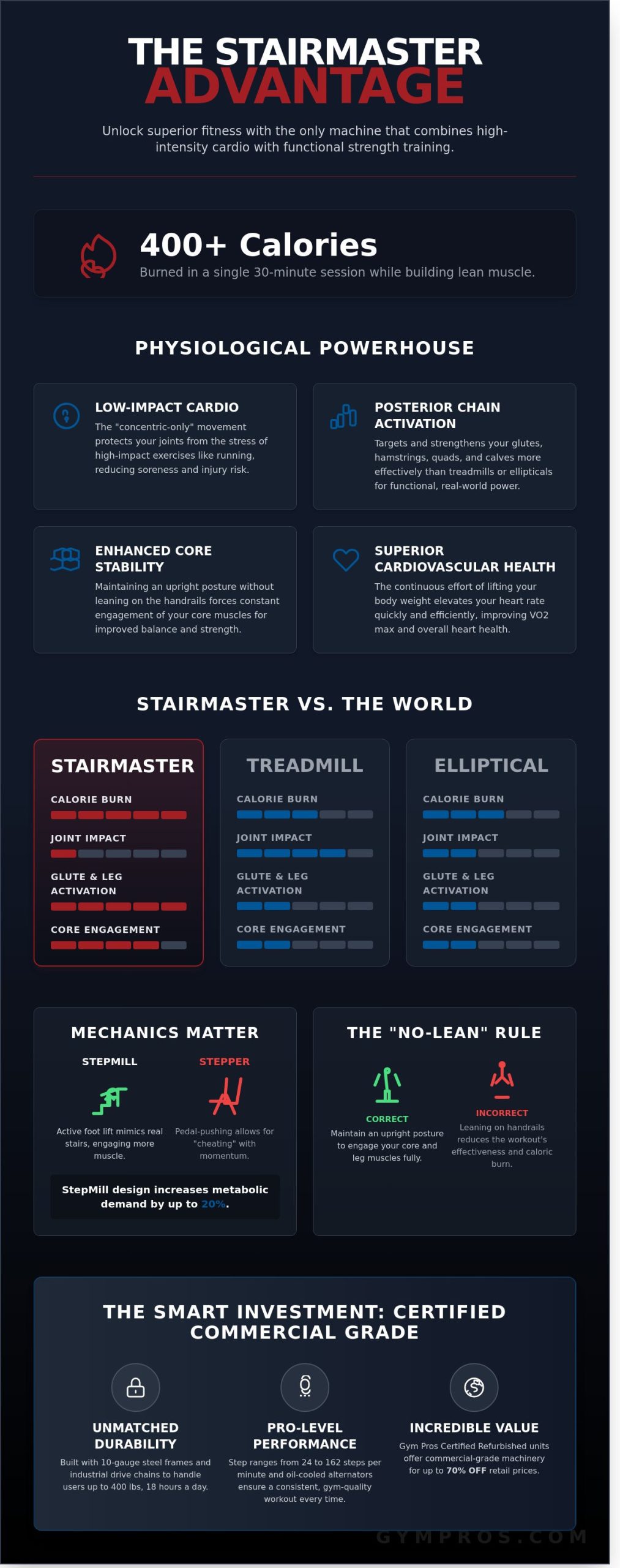
Distinguishing between a pedal-based stepper and a true StepMill is vital for any serious trainee. A pedal-based stepper allows you to keep your feet in constant contact with the machine, which often leads to “cheating” by using momentum or leaning on the handrails to depress the pedals. The StepMill demands an active foot lift. You must physically pick up your leg and place it on the next rising step. This action triggers superior hip flexor engagement and mimics real-world functional movement patterns like climbing a flight of stairs or hiking a steep trail. Research indicates that lifting 100% of your body weight against gravity, rather than just pushing a lever, increases metabolic demand by as much as 20% compared to pedal-based alternatives.
This focus on functional movement highlights the importance of real stairs in our daily lives, not just in the gym. For those inspired to improve their own home’s staircase, perhaps as a home improvement project to complement a new home gym, resources from specialists like Svenska trappsteg can provide excellent ideas, even for those outside of Sweden.
Commercial vs. Residential Build Quality
When you’re investing in a piece of equipment that will endure thousands of steps, build quality is everything. Commercial-grade units are built with 10-gauge steel frames and industrial-grade drive chains designed to handle 400-pound user capacities for 18 hours of daily use. This rigidity isn’t just about durability; it’s about user confidence. A rock-solid frame prevents the swaying and “give” found in cheap residential models, allowing you to focus on high-intensity intervals without distraction.
For the savvy fitness enthusiast, GymPros Certified refurbished units represent the peak of value. You can secure investment-grade, commercial machinery for up to 70% off retail prices. These aren’t just used machines. They are remanufactured to meet strict performance standards, ensuring the drive-chain and alternator function like new. Choosing a certified pre-owned commercial unit over a flimsy new residential model is the best way to bring the gym-quality experience into your home. It’s a professional-grade solution for those looking to maximize stairmaster benefits without the premium price tag of a brand-new industrial unit.
- Durability: Commercial units feature oil-cooled alternators for heat dissipation.
- Safety: Infrared safety sensors at the base prevent accidents.
- Performance: Step ranges typically vary from 24 to 162 steps per minute.
Investing in a StepMill is a commitment to a higher standard of fitness. It’s a rugged, reliable partner that doesn’t accept excuses. Whether you’re training for a mountain summit or simply looking to torch body fat, the gravity advantage of the StairMaster is unbeatable.
The Physiological Benefits of StairMaster Training
The StairMaster is a high-performance tool designed for serious results. It forces your body to work against gravity with every step. This vertical displacement creates a metabolic demand that flat-surface walking cannot match. You’ll burn significantly more calories at a speed of 3 miles per hour on a climber than you would at the same pace on a treadmill. This efficiency is why the machine remains a staple in professional training facilities. According to the Cleveland Clinic on StairMaster benefits, this movement pattern strengthens the heart and lungs while simultaneously building lower body power. It is a dual-purpose investment in your health.
Posterior chain activation is another primary advantage. Each step requires a forceful extension of the hip and knee. This targets the gluteus maximus, hamstrings, and calves with precision. Beyond muscle growth, the StairMaster serves as a critical tool for skeletal health. Research indicates that weight-bearing exercises like stair climbing can increase bone mineral density by 2% or more over a 6-month period. This makes it an investment-grade choice for long-term durability. Despite the intensity, the machine is remarkably gentle on the body. Unlike running, which exerts a force of 3 to 4 times your body weight on your joints, the climber keeps one foot in contact with the steps. This reduces peak impact forces by approximately 50%, making it a top-tier option for athletes with knee or ankle sensitivities.
The ‘Glute-Sculpting’ Myth vs. Reality
The “myth” isn’t that the machine works; it’s that results happen without intention. The gluteus maximus reaches peak activation during the “push-off” phase of the climb. You maximize this by driving through the heel rather than the toes. Data shows that stair climbing elicits up to 50% more gluteal muscle recruitment than walking on a flat surface. While lunges and squats are effective, the StairMaster allows for hundreds of repetitions in a single session. This high-volume approach builds muscular endurance that traditional lifting cannot replicate. To see the best stairmaster benefits, maintain an upright posture and avoid leaning on the handrails. This ensures your legs carry the full load of your body weight.
Cardio for the ‘Time-Poor’ Athlete
Efficiency is the primary driver for our commercial clients. Time is a finite resource. A 20-minute session on a commercial-grade climber often yields the same cardiovascular load as a 40-minute jog on flat ground. This is largely due to the “Afterburn Effect,” formally known as Excess Post-exercise Oxygen Consumption (EPOC). High-intensity climbing keeps your metabolic rate elevated for up to 24 hours after you leave the gym. This vertical training accelerates fat oxidation by keeping the heart rate in a higher zone with less mechanical stress. If you are looking to bring this level of performance into your home or facility, you can find certified pre-owned climbers that deliver these professional results at a fraction of the retail cost. Investing in a machine that maximizes your 20-minute window is a savvy business move for your fitness. These stairmaster benefits prove that you don’t need hours of cardio to see elite-level changes in your body composition.
StairMaster vs. The World: A Comparative Analysis
The StairMaster isn’t just another machine in the rows of cardio equipment; it’s a specialized tool for those who demand more from their floor space. While treadmills and ellipticals have their place, the StairMaster offers a unique profile of intensity and efficiency. A 175-pound athlete can burn 360 to 420 calories in a 30-minute session. This outperforms the elliptical, which often averages 270 to 310 calories for the same duration. The difference lies in the vertical climb. You aren’t just moving your legs; you’re fighting gravity. This constant resistance ensures that your heart rate reaches the target zone 15% faster than on a flat running surface.
This machine serves as the ultimate hybrid between traditional cardio and functional strength. It engages the glutes, hamstrings, and quads through a full range of motion. Unlike the treadmill, the StairMaster eliminates the harsh impact of the foot strike. This makes it a preferred choice for individuals looking to preserve joint health over a 20-year fitness journey. The StairMaster also wins on floor efficiency. A standard commercial treadmill requires a footprint and safety clearance of roughly 28 square feet. A StairMaster typically occupies only 14 square feet. This 50% reduction in space makes it an investment-grade choice for home gyms. You must maintain an upright posture without leaning on the handrails to get the full stairmaster benefits. This constant stabilization recruits the transverse abdominis and obliques throughout the entire workout.
The psychological grit factor is a defining characteristic of the climb. Running allows for coasting or momentum, but the stairs are relentless. If you stop moving, the steps keep coming. This creates a mental toughness that transfers to other areas of life. It’s about more than just lung capacity; it’s about the discipline to keep climbing when your legs feel heavy. For the savvy trainee, this mental edge is as valuable as the physical conditioning.
StairMaster vs. Treadmill for Fat Loss
Many users believe a 15% incline treadmill walk is equivalent to a stair climb. Data suggests otherwise. Walking on an incline still relies on the belt’s momentum to assist the gait cycle. On a StepMill, the user must physically lift their center of mass with every repetition. This results in a 20% higher heart rate response compared to incline walking at similar speeds. Safety is another factor. A treadmill belt moving at 8 MPH is a significant trip hazard during fatigue. The StairMaster moves only as fast as you step, providing a controlled environment for maximizing your stairmaster benefits during high-intensity intervals.
Pairing Cardio with Strength
Effective programming involves using the StairMaster as a high-intensity primer. A 10-minute climb at a moderate pace increases core temperature and activates the posterior chain better than a standard bike. After completing your climb, transition immediately to resistance training. Using commercial-grade Hoist equipment for leg presses or lunges allows you to capitalize on the pre-exhaustion created by the stairs. This combination accelerates muscle hypertrophy and metabolic rate. It’s a proven strategy for those looking to build powerful legs without spending two hours in the facility. Integration is simple: use the stairs for dynamic warm-ups or as a finisher to deplete remaining glycogen stores.
Beyond the gym, combining this high-intensity work with low-impact activities like swimming creates a balanced, year-round fitness plan. For those with a home pool, ensuring it’s well-maintained is crucial for this kind of cross-training, and professionals such as The Pool People offer expert guidance.
Maximizing Your Results: Form, Workouts, and Safety
Mastering the technical execution of your climb is the fastest way to unlock the full spectrum of stairmaster benefits. Most users treat the machine as a passive cardio tool, but it’s actually a precision instrument for lower body hypertrophy and metabolic conditioning. To get the most out of your investment, you must prioritize mechanical efficiency over raw speed.
The “No-Lean” Rule is the most critical protocol for any serious trainee. Research indicates that leaning heavily on the handrails can reduce your total caloric expenditure by as much as 20% to 25%. When you support your body weight with your arms, you’re essentially cheating your legs out of the work they’re designed to do. Keep your hands off the rails entirely or use a light, two-finger touch for balance only. This forces your core to stabilize your torso, turning a simple leg workout into a full-body stabilization challenge.
Your foot placement dictates which muscle groups bear the brunt of the load. To maximize glute recruitment, focus on driving through the entire foot, specifically pressing through the heel as you step up. If your goal is to isolate the quadriceps and calves, you can shift your weight slightly toward the balls of your feet. However, you should never let your heels hang off the edge of the step, as this places unnecessary strain on the Achilles tendon. Maintain a neutral spine and keep your gaze forward. Looking down at your feet for 30 minutes rounds the upper back and can lead to chronic neck strain.
Safety starts before you hit the start button. Always verify the location of the emergency stop cord or button. Commercial-grade machines often feature infrared sensors at the base of the stairs that trigger an automatic stop if they detect an obstruction. When mounting, wait for the steps to be completely stationary. When you’re finished, stay on the machine until the belt has come to a full stop to avoid vertigo or a loss of balance.
The Viral 25-7-2 Workout and Beyond
The 25-7-2 method has gained massive traction for its simplicity and effectiveness. You set the machine to Level 7 and climb for 25 minutes, twice a week. It’s a high-yield routine that builds consistent aerobic capacity. For those seeking advanced conditioning, High-Intensity Interval Training (HIIT) is superior. Try 60 seconds of a high-speed climb followed by 60 seconds at a recovery pace. If longevity is your goal, stick to Zone 2 training. Maintain a steady pace where your heart rate stays between 65% and 75% of your maximum for 45 minutes to optimize mitochondrial health.
Common Mistakes to Avoid
Slumping over the console is a habit that ruins your results. This posture increases shear force on the lumbar spine by roughly 30% and restricts your lung capacity. If you find yourself hunching, the speed is too high. Lower the intensity until you can stand tall. Additionally, avoid skipping steps unless you have the foundational strength to maintain a 90-degree knee angle. Skipping steps without control leads to joint jarring rather than muscle building. Focus on rhythmic, deep breathing through the nose to maintain oxygen saturation during steep climbs.
Bringing the Pro Gym Home: Why a Refurbished StairMaster Wins
Owning a commercial-grade StairMaster shouldn’t require a commercial-sized bank account. You can secure the same rugged durability found in elite health clubs while saving up to 70% off the original MSRP. Choosing a remanufactured unit isn’t just a budget move; it’s a strategic investment in professional-tier hardware that holds its value. One of the primary stairmaster benefits is its legendary longevity. These machines are engineered to run 12 hours a day for 365 days a year. When you bring that level of industrial engineering into a home setting, you’re buying a piece of equipment that will likely last a lifetime. It’s the difference between a flimsy retail-grade climber and a machine built for heavy-duty performance.
The financial logic is simple. A brand-new commercial StepMill can cost upwards of $10,000. By choosing a GymPros certified unit, you’re redirecting those savings into other areas of your life while still accessing the same calorie-burning power. Beyond the money, there’s a significant environmental impact. Every remanufactured unit keeps approximately 500 pounds of steel and high-grade plastics out of landfills. You’re participating in a circular economy that prioritizes craftsmanship over disposable consumerism. We provide a comprehensive warranty on every unit, ensuring your long-term fitness investment is protected by experts who know these machines inside and out.
The Gym Pros Refurbishment Advantage
Our 30-point certification process is the gold standard in the fitness industry. We don’t just wipe down the frame and call it “used.” Our technicians perform a full mechanical overhaul on every machine. We test the alternator under varying load levels to ensure consistent resistance. We replace every worn drive chain and install fresh, precision-sealed bearings to guarantee a smooth, quiet climb. The cosmetic restoration is just as intense. We strip the frames and apply a professional-grade powder coating to eliminate any signs of previous wear. Brands like StairMaster are investment-grade because they use heavy-duty components that don’t fail under pressure. When we’re finished, your machine looks and performs as if it just rolled off the factory floor in 2024.
Logistics and Installation
A StairMaster is a serious piece of machinery, often weighing over 400 pounds. You shouldn’t have to worry about wrestling it up a steep driveway or through narrow doorways. Our white-glove delivery service includes professional assembly and placement in your room of choice. Our team handles the heavy lifting so you can focus on your first workout. Before you order, verify your space requirements. Most StepMills require a minimum ceiling height of 9 feet to ensure you have enough clearance at the top of the stairs. While the height is significant, the footprint is surprisingly compact. Most models only require about 58 inches by 34 inches of floor space, making them easier to fit into a corner than a standard treadmill. These units provide maximum stairmaster benefits without demanding a massive amount of square footage.
Ready to elevate your home training with a machine that’s built to last? Browse our current inventory of certified StairMaster StepMills and find the perfect fit for your fitness goals today.
Secure Your Commercial-Grade Edge Today
The StairMaster remains the gold standard for vertical training because it delivers twice the metabolic efficiency of a standard treadmill. By engaging your glutes and hamstrings against constant gravitational resistance, you’re building functional power while burning up to 400 calories in just 30 minutes. These stairmaster benefits aren’t just for elite athletes; they’re essential for anyone serious about longevity and cardiovascular health in 2026. You don’t need to pay full retail to own this level of performance. We’ve been an A+ Rated BBB business since 2003, specializing in bringing top-tier machinery into your home without the premium price tag.
Every StepMill we sell undergoes our industry-leading 30-point certification process to ensure it meets original factory specifications. We handle the heavy lifting with nationwide white-glove delivery and installation; your only job is to start climbing. It’s time to invest in equipment that works as hard as you do. Join the savvy fitness enthusiasts who choose remanufactured excellence over overpriced plastic alternatives.
Shop Certified Refurbished StairMaster StepMills and Save Up to 70%
Take the first step toward a stronger version of yourself. Your peak performance is just one flight away.
Frequently Asked Questions
Is 20 minutes on the StairMaster enough to see results?
Yes, a 20 minute session is highly effective if you maintain a heart rate between 75% and 85% of your maximum. This duration is sufficient to trigger the metabolic stairmaster benefits while building functional strength in your lower body. High-intensity interval training on a commercial-grade machine ensures you maximize every minute. You’ll likely see improvements in cardiovascular endurance and muscle tone within 4 to 6 weeks of consistent effort.
Does the StairMaster really help you lose belly fat?
You can lose belly fat by using the StairMaster to create a consistent caloric deficit. While spot reduction is a myth, this machine burns approximately 2 times more calories than walking at a brisk pace on flat ground. By engaging large muscle groups like the glutes and quads, you elevate your metabolic rate for hours after the workout. This investment-grade cardio approach helps reduce total body fat percentage over a 90 day period.
Is it okay to use the StairMaster every day?
You shouldn’t use the StairMaster every day because your muscles require at least 48 hours to recover from high-resistance climbing. Professional trainers recommend a schedule of 3 to 5 days per week to prevent overuse injuries and fatigue. This cadence allows your joints to adapt to the vertical load while ensuring you maintain peak performance during every session. Overtraining can lead to a 15% decrease in power output, so prioritize recovery.
Why is the StairMaster so much harder than the treadmill?
The StairMaster feels harder than a treadmill because you’re lifting 100% of your body weight against gravity with every single step. Unlike a treadmill where the belt assists your stride, a revolving staircase requires active muscle engagement to move vertically. This constant resistance increases your heart rate by 20% compared to flat-surface running at a similar perceived exertion. It’s a top-tier challenge that builds superior functional power and metabolic efficiency in less time.
Can using a StairMaster help with knee pain or rehabilitation?
Using a StairMaster can assist in rehabilitation because it provides a low-impact workout with nearly 0% of the jarring force found in running. Running subjects your knees to 3 times your body weight in impact force, while climbing is a controlled, fluid motion. However, you must maintain a 90 degree knee angle and avoid leaning forward to protect the joint. Consult a physical therapist to ensure this commercial-grade equipment fits your specific recovery protocol.
How many calories does 30 minutes on a StairMaster burn?
A 180 pound individual typically burns between 320 and 400 calories during a 30 minute session on a StairMaster. This high caloric output is one of the primary stairmaster benefits for those seeking efficient weight management. Your exact burn depends on the intensity level and whether you’re using the machine’s built-in resistance programs. Compared to a standard elliptical, you’ll likely see a 25% increase in total energy expenditure over the same duration.
What is the difference between a StairMaster and a StepMill?
StairMaster is the brand name, while a StepMill refers specifically to the machine with a revolving flight of stairs. Many people use the terms interchangeably, but a true StepMill provides a 100% authentic climbing experience with standard 8 inch step heights. Other StairMaster models might include pedals that move in a stepping motion without the revolving belt. For a comprehensive breakdown of all models and features, check out our complete StairMaster guide for 2026. Choosing a remanufactured StepMill ensures you get the most rugged, industrial-strength workout available in the market.
Is it better to hold the rails or go hands-free on a StairMaster?
You’ll achieve better results by going hands-free, as leaning on the rails can reduce your total calorie burn by up to 20%. Gripping the handles tightly shifts your weight to your upper body and takes the load off your legs and core. Use the rails only for light balance or during high-speed intervals to ensure safety. Maintaining an upright posture ensures you maximize the physical gains and develop better functional balance for daily activities.