Why settle for a standard treadmill when a StairMaster machine can double your metabolic output in half the time? According to data from Harvard Health, a 155-pound individual burns approximately 216 calories in just 30 minutes of stepping. However, many fitness enthusiasts hesitate to commit because of high-ticket retail costs or the fear that improper form will lead to chronic knee strain. You want the lower-body power of a pro athlete without the premium price point or a trip to the physical therapist. We believe everyone should have access to commercial-grade durability without the typical retail headache.
We know that choosing between the Stairmaster 4 G and the Gauntlet feels like a high-stakes gamble when you don’t have the technical facts. This guide promises to eliminate the guesswork by teaching you how to operate, maintain, and select an investment-grade unit that lasts for decades. You’ll discover how to secure a Gym Pros certified model at a fraction of the cost while mastering the posture cues that keep your joints safe. We are providing a methodical breakdown of the 2026 market so you can buy with confidence and train with purpose.
Key Takeaways
-
Discover why the revolving staircase design offers a superior functional workout compared to traditional steppers for elite cardio results.
-
Master the professional "hinged" posture to maximize glute activation and shift the workload from your joints to your muscles.
-
Navigate the technical differences between residential units and commercial-grade legends to select the perfect stairmaster machine for your specific goals.
-
Protect your investment with a 10-minute maintenance routine designed to prevent corrosion and ensure a smooth, silent drivetrain.
-
Learn the expert mounting procedures and safety protocols used by industry insiders to ensure a secure and high-intensity training session.
Table of Contents
What is a StairMaster Machine? Understanding the Legend
The StairMaster isn’t just a piece of equipment; it’s a fitness icon. Since its debut in 1983, this revolving staircase has dominated the cardio floor. While generic "steppers" exist, the authentic
[stairmaster machine
](https://www.gympros.com/product-category/stair-climbers/stairmaster-machines-for-sale/)remains the benchmark for vertical climbing. Looking back at the
[history of the StairMaster
](https://en.wikipedia.org/wiki/StairMaster), you’ll see a transition from simple hydraulic pedals to the 2026 high-tech OpenHub consoles that define modern commercial gyms.
To see this machine in action and master the basics, watch this beginner-friendly guide:
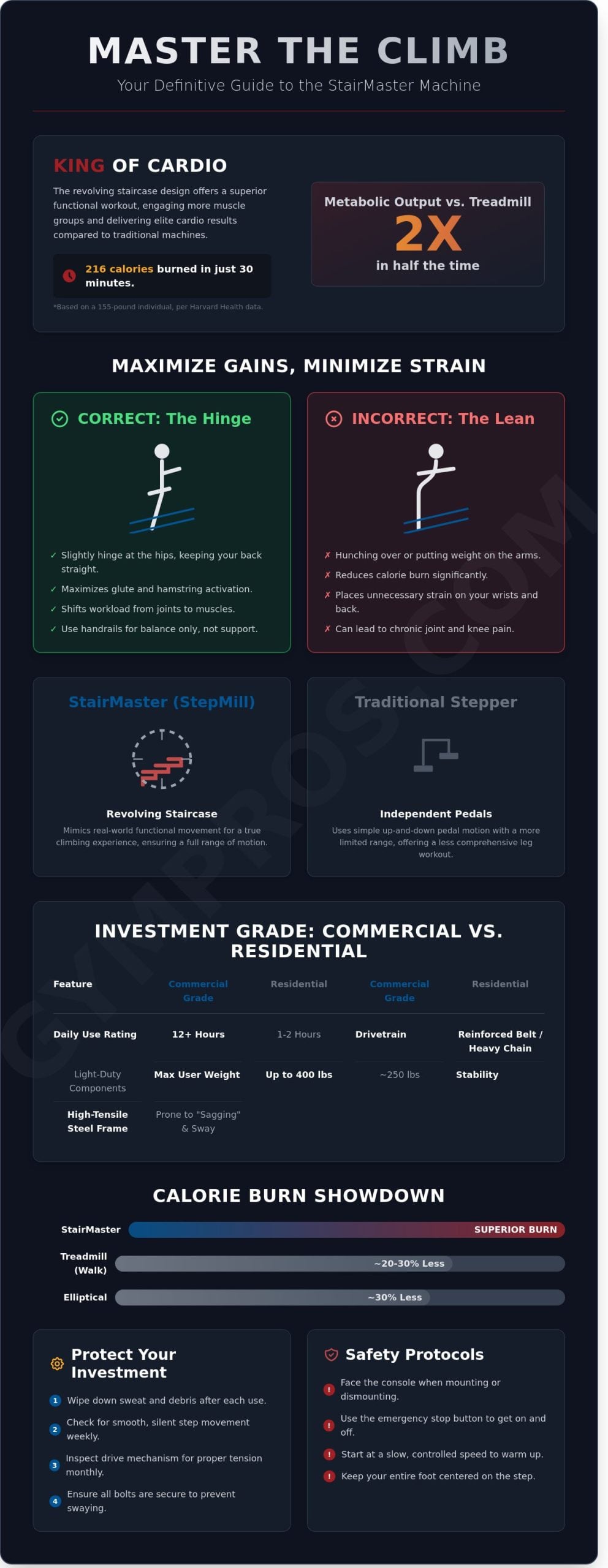
A StepMill features actual revolving stairs, forcing a full range of motion. A standard stepper uses pedals that move up and down. The StepMill is superior because it mimics real-world functional movement. It’s built for heavy use. Commercial-grade machines typically support user weights up to 400 pounds, ensuring stability during high-intensity intervals. Investing in commercial-grade equipment means you’re getting a frame and motor designed to run for 12 or more hours a day without failure.
The Anatomy of a StairMaster
The core of a
[stairmaster machine
](https://www.gympros.com/product-category/stair-climbers/stairmaster-machines-for-sale/)is the revolving staircase, often featuring 8-inch steps with anti-slip technology. Modern units include ergonomic handrails and a prominent emergency stop system for safety. Consoles have evolved significantly. You can now choose between classic LED displays and 15-inch OpenHub touchscreens that offer streaming and workout tracking. These high-tech interfaces allow users to virtually climb landmarks like the Eiffel Tower, making the grueling workout more engaging.
StairMaster vs. Other Cardio Equipment
Climbing burns roughly 20% to 30% more calories per hour compared to walking on
[commercial treadmills
](https://www.gympros.com)or operating most elliptical machines, highlighting its superior caloric expenditure.
The Mechanics of Vertical Climbing: How it Works
A stairmaster machine isn’t just a revolving ladder; it’s a sophisticated piece of engineering designed to manage gravity. The core of this system relies on a heavy-duty drivetrain that dictates the quality of your movement. While older units utilized a chain-and-sprocket system similar to a motorcycle, modern premium models often use reinforced belt drives. These belts eliminate the jerky "catching" sensation found in budget equipment. Cheap retail alternatives often suffer from "sagging" because their light-duty components can’t handle the instant torque of a 220-pound user. Commercial-grade builds use high-tensile steel to ensure every step feels solid and secure.
Research from Harvard Health Publishing notes that stair climbing for endurance and balance is a premier cardiovascular indicator. To facilitate this safely, the machine uses an electronic braking system. This system utilizes an industrial alternator to create electromagnetic resistance. It doesn’t just let the stairs drop; it precisely counters your weight to maintain a steady cadence. This allows for a controlled descent that protects your joints while maximizing caloric burn.
Modern units also feature load sensing technology. This software adjusts the resistance 30 times per second to ensure the speed remains constant regardless of whether you weigh 150 or 300 pounds. This level of precision is why professional athletes rely on these units for consistent metabolic conditioning. You get a predictable, investment-grade workout every time you step on the platform.
Internal Components and Durability
The alternator is the heart of speed regulation. In a professional stairmaster machine, these components are rated for 10 or more hours of daily use. Heavy-duty steel frames, often weighing over 450 pounds, provide the necessary ballast to prevent swaying during high-intensity intervals. You won’t find this stability in plastic-heavy retail models. For a detailed breakdown of how these designs have evolved over the decades, see our StairMaster Guide 2026.
Noise Levels and Residential Use
For home gym owners, the noise level is a primary concern. Multi-ribbed poly-V belts have replaced noisy chains to reduce decibel levels by approximately 20 to 30 percent. Vibration dampening pads and rubberized leveling feet isolate the mechanical energy from your subfloor. This makes a certified pre-owned StairMaster a viable option even for second-floor installations. Investing in commercial-grade gear means you get a whisper-quiet workout that lasts for decades without the maintenance headaches of cheaper builds.
How to Use a StairMaster Machine for Maximum Results
Safety starts before the first step. Always verify the emergency stop cord is functional and clear of the revolving stairs. Begin by standing on the stationary side platforms rather than the moving steps. This prevents sudden jolts to your joints when the motor engages. Once you select your program, maintain a hinged posture. A 15 degree forward lean at the hips is the gold standard for glute activation. This position stretches the gluteus maximus, forcing it to produce more power during the ascent. Avoid standing perfectly upright, as this shifts the workload almost entirely to your quadriceps and increases spinal compression.
Many users compromise their results by leaning heavily on the handrails. This common error can reduce your total caloric expenditure by 20% because the machine supports your body weight instead of your legs. Treat the rails as a balance aid, not a crutch. Similarly, avoid "short-stepping." This occurs when you take rapid, shallow steps at the top of the rotation. To maximize muscle fiber recruitment, let the step descend until your knee is at a 90 degree angle before driving upward. Investing in a stairmaster machine for your facility or home gym requires a commitment to this technical precision to see a true return on investment.
Perfecting Your Climbing Form
Drive through your heels to engage the entire posterior chain. Toe-striking places excessive strain on the calves and knees, often leading to premature fatigue. For an advanced challenge, try the "No-Hands" method. By hovering your hands just above the rails, you force your core stabilizers to maintain your equilibrium. This turns a cardio session into a functional balance workout. Control your breathing with a 2:2 rhythm; inhale for two steps and exhale for two steps. This steady oxygen flow prevents the side stitches common in vertical training.
2026 Workout Trends: HIIT and LISS
Metabolic conditioning in 2026 prioritizes efficiency through high-intensity interval training (HIIT). A proven 20 minute protocol involves 30 seconds of sprinting at level 15 or higher, followed by 60 seconds of recovery at level 5. This 1:2 ratio spikes the heart rate into Zone 4, creating an afterburn effect that lasts for 14 hours post-workout. Conversely, use Low-Intensity Steady State (LISS) for active recovery days. Keep your heart rate between 60% and 70% of your maximum. This promotes blood flow to sore muscles without overtaxing the central nervous system. Using a commercial-grade stairmaster machine allows for these precise level adjustments, ensuring your heart rate stays within the targeted metabolic window.
Maintenance and Space Prep: Protecting Your Investment
Before you take delivery, measure your space twice. Most commercial-grade units require a ceiling height calculated by adding the machine’s step height to the user’s height, plus an extra 12 inches for head clearance. If you’re 6 feet tall and the machine base is 14 inches high, you need at least an 8.5-foot ceiling. Floor loading is equally critical. A 400lb machine concentrated on four small feet can damage hardwood or crack thin tiles. Use a 3/4-inch high-density equipment mat to distribute the weight and dampen vibrations. This protects your flooring and reduces the noise profile during high-intensity sessions.
The Gym Pros 30-Point Certified Check
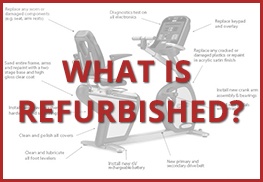
We don’t just sell used gear. Every refurbished StairMaster undergoes a rigorous 30-point inspection. Our technicians replace high-wear items like drive chains, sealed bearings, and step bushings as a standard procedure. We also perform software calibration to ensure the console is ready for 2026 fitness apps and heart rate monitors. This process guarantees your stairmaster machine arrives in peak mechanical condition. You get the performance of a new unit at a fraction of the retail cost.
Home Installation Logistics
Moving a 400lb steel tower requires tactical planning. Standard doorways are 32 inches wide, while many StairMaster models exceed 34 inches without disassembly. Check your path for tight 90-degree corners before the delivery truck arrives. For power, these machines generally pull 15 to 20 amps. We recommend a dedicated circuit to prevent tripped breakers during high-intensity intervals. While DIY assembly is possible, professional installation eliminates the risk of misaligned chains or stripped bolts. Mistakes during setup account for 25% of early service calls. Our team handles the heavy lifting so you can focus on your first workout.
Ready to upgrade your home gym with industrial-grade durability? Browse our certified StairMaster inventory today and save up to 70% off retail prices.
Choosing the Right Model: Finding Your Perfect Match
Selecting a stairmaster machine requires balancing your available floor space against your performance demands. While every model delivers a high-intensity workout, the engineering varies significantly between residential and commercial units. Making the right choice ensures your investment lasts for decades rather than just a few seasons of heavy use.
The SM3 addresses the most common hurdle for home gym owners: ceiling height. Most standard rooms have 8-foot ceilings, which can be too low for full-sized commercial units. The SM3 is specifically designed to fit in these tighter spaces while still providing a professional-grade climbing experience. In contrast, the 8-Series Gauntlet is the gold standard found in 90% of global health clubs. It’s built to withstand 16+ hours of daily operation, making it an indestructible option for those who want the absolute best. Investing in StairMaster StepMills for your home brings that same club-level durability into a private setting without the premium price tag of a new retail unit.
Performance seekers often gravitate toward the Gauntlet because of its wider step surface and heavier drive system. It utilizes an electronically controlled alternator to manage step speed, which provides a smoother feel than the friction-based systems found in cheaper alternatives. If you’re training for a specific event or looking to burn maximum calories, the commercial-grade mechanics are unbeatable.
Feature Breakdown by Series
Choosing between models often comes down to the tech and the footprint. The SM3 is the compact solution, featuring a smaller frame that doesn’t sacrifice the revolving staircase design. It offers a step range of 26 to 162 steps per minute, which is more than enough for 95% of fitness enthusiasts. For those who want the ultimate in tech and durability, the 8-Series Gauntlet features rust-free polypropylene steps and a broader speed range. You can also customize your experience with various console options. The Landmark Challenge program is a fan favorite, allowing users to virtually climb 20 of the world’s most famous structures, including the Eiffel Tower and the Taj Mahal.
The Savings Advantage at Gym Pros
Securing a stairmaster machine shouldn’t drain your bank account. At Gym Pros, we help you get commercial quality at 70% off retail prices. We don’t just sell used equipment; we provide investment-grade machinery that has been meticulously inspected. Our technicians perform a multi-point certification process on every unit to ensure it meets our rigorous standards for performance and safety. This "GymPros Certified" stamp gives you the peace of mind that your machine will perform like new on day one and day one thousand. We also offer extended warranty plans to protect your investment, covering parts and labor so you can focus entirely on your fitness goals.
To finalize your decision, use this quick checklist:
-
Ceiling Height: Measure your height plus the machine’s step-up height to ensure at least 2 feet of clearance.
-
Budget: Determine if you want a base model or a fully featured 8-Series with a touchscreen.
-
Fitness Goals: If you’re training for mountain climbing or high-stakes athletics, the commercial Gauntlet is the superior choice.
Browse our current StairMaster inventory today!
Take the Next Step Toward Elite Performance
Mastering the stairmaster machine involves more than just stepping; it requires a deep understanding of vertical mechanics and a commitment to consistent maintenance. You’ve now gained the technical knowledge to optimize your workouts and select a model that fits your specific 2026 fitness goals. Transitioning from a casual user to a savvy owner means choosing equipment that offers durability without the premium retail markup. Investing in commercial-grade machinery ensures your training remains uninterrupted and effective for years to come.
Gym Pros provides the ultimate solution for those seeking top-tier quality at a fraction of the cost. You can save up to 70% off retail prices while securing a piece of equipment that feels and performs like new. Every machine we sell undergoes our signature 30-Point Certified Refurbishment Process to guarantee mechanical integrity. We simplify the logistics by offering nationwide delivery and professional installation directly to your door. You don’t have to compromise on quality to stay within your budget.
Shop Certified Refurbished StairMaster Machines
Your journey toward peak physical condition starts with the right tools. We’re ready to help you reach the top.
Frequently Asked Questions
Is the StairMaster machine better than a treadmill for weight loss?
The StairMaster machine is significantly more efficient for weight loss because it burns approximately 320 calories in 30 minutes for a 180-pound person. This outperforms a treadmill at a 3.0 mph pace, which typically burns about 240 calories in the same timeframe. The 33% increase in caloric expenditure occurs because climbing engages the glutes and hamstrings more intensely than walking on a flat surface.
How much ceiling height do I need for a StairMaster at home?
You need a minimum ceiling height of 9.5 feet to safely accommodate a commercial-grade stairmaster machine like the 8-Series Gauntlet. These units have a step-up height of 9 inches and the user stands about 3 feet above the floor at the peak of their stride. Always measure your tallest user and add 12 inches of clearance to ensure they don’t hit the ceiling during high-intensity intervals.
Can I use a StairMaster every day or is it too intense?
Daily use is possible if you rotate intensity levels, though 3 to 5 sessions per week is the optimal range for most athletes. The American Council on Exercise recommends 48 hours of recovery between high-intensity resistance sessions to prevent overtraining. If you choose to climb daily, keep 70% of your workouts at a moderate steady-state pace to protect your joints and central nervous system.
What is the difference between a StairMaster and a StepMill?
A StepMill uses a revolving staircase design that mimics a real flight of stairs, while the original StairMaster name often referred to pedal-based steppers. The StepMill 7000PT popularized the rotating staircase in 1983 and remains the industry standard for functional movement. Most fitness professionals now use the terms interchangeably, but the revolving staircase provides a superior range of motion for lower body development and cardiovascular conditioning.
How do I stop my knees from hurting on the StairMaster?
Stop knee pain by keeping your entire foot flat on the step and avoiding the common habit of climbing on your toes. Research indicates that pushing through the heel shifts the mechanical load from the patella to the stronger posterior chain muscles. Maintain an upright posture and avoid leaning on the handrails; a 15-degree forward lean often causes tracking issues and unnecessary strain on the knee joint.
What maintenance does a used StairMaster require?
A used unit requires a weekly inspection of the drive chain and a monthly lubrication of the main drive bearings to ensure smooth operation. Dust and sweat contribute to 90% of mechanical failures in commercial equipment, so you must wipe down the steps after every session. Check the alternator brushes every 500 hours of use to maintain consistent resistance levels and prevent unexpected downtime.
Are refurbished StairMasters as good as new ones?
GymPros Certified refurbished units perform identically to new machines because they undergo a rigorous 25-point inspection and parts replacement process. We replace high-wear components like drive belts and chains with OEM parts to meet original factory specifications. This remanufacturing process delivers a top-tier stairmaster machine that offers the same durability as a new unit while providing savings of up to 70% off retail prices.
What is the best StairMaster model for a home gym in 2026?
The StairMaster 10G is the premier choice for 2026 because it features the innovative OverDrive Training Mode and 25 distinct levels of resistance. It offers the widest steps in the industry at 22 inches, which provides a stable platform for both traditional climbing and lateral movements. This investment-grade machine is engineered to handle 10 hours of daily use, making it a permanent, reliable fixture for any high-performance home gym.