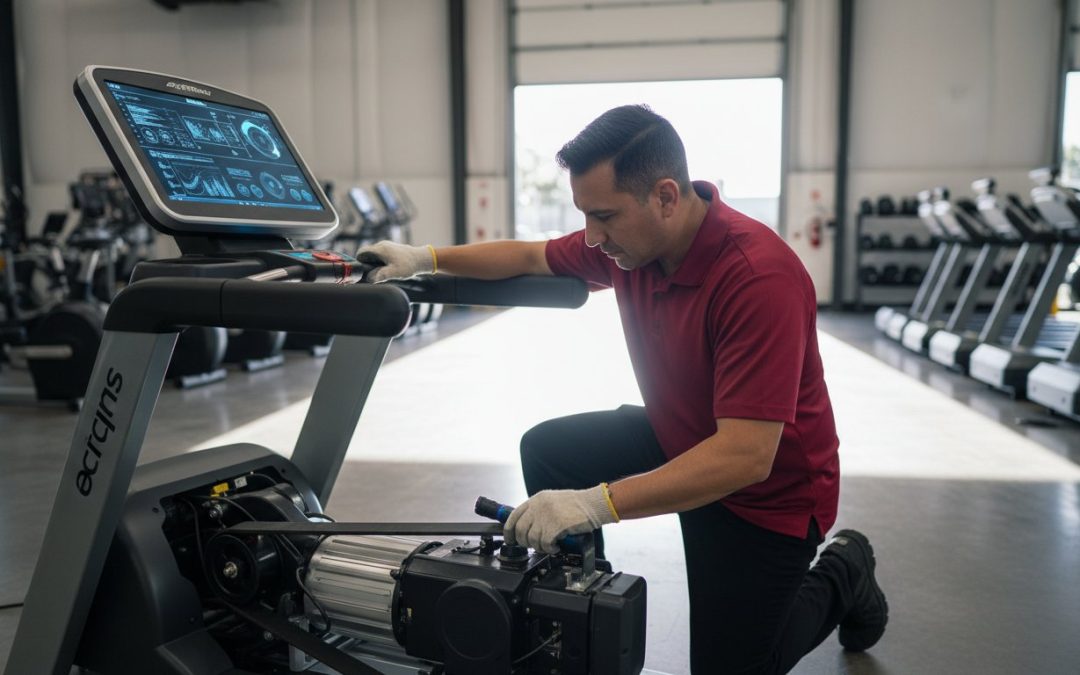
A single $2,400 motor controller failure can instantly turn your “unbeatable deal” into a high-priced paperweight. You know that investing in top-tier brands like Life Fitness or Matrix is the smartest way to save 70% off retail, but the fear of hidden mileage or a discontinued motherboard keeps most buyers on the sidelines. It’s frustrating to stand in front of a machine and wonder if you’re looking at a certified gem or a ticking time bomb. Knowing exactly how to inspect used commercial gym equipment is the only bridge between a risky gamble and an investment-grade purchase for your facility.
We’ve spent 15 years perfecting the remanufacturing process, and now we’re handing you the keys to our technical vault. You’ll learn the exact 20-point diagnostic protocol our certified technicians use to verify electronic integrity and structural durability before any machine hits our floor. We’ll show you how to pull error logs from a 2024 console, check for drive belt fraying, and identify the subtle signs of bearing wear that most amateurs miss. By the end of this 2026 guide, you’ll have the technical authority to negotiate like a pro and the confidence to secure commercial-grade excellence for your home or club.
Key Takeaways
- Learn how to inspect used commercial gym equipment by accessing hidden technician menus to uncover true usage hours and avoid high-mileage machines.
- Identify critical structural red flags, such as hairline fractures in 11-gauge steel frames, to ensure your investment-grade gear remains safe and durable.
- Master the professional “Fray Test” for cables and pulleys to distinguish between minor cosmetic wear and legally unsafe mechanical failures.
- Understand the vital differences between risky “as-is” sellers and the Gym Pros 30-Point Certified Process to secure top-tier performance at a fraction of retail costs.
- Navigate the complexities of commercial warranties and “White Glove” logistics to guarantee a seamless, professional installation for your facility.
The Fundamentals of Commercial-Grade Inspection: Frame and Foundation
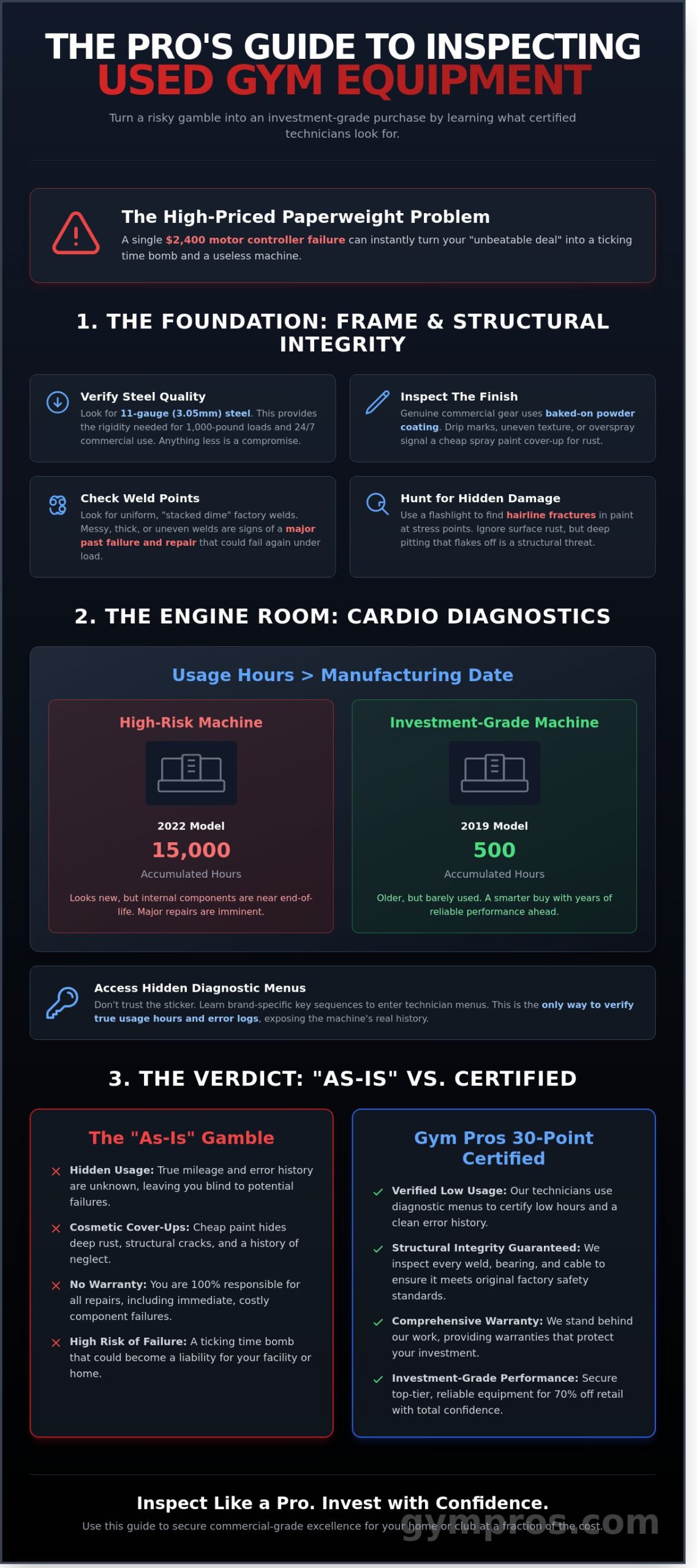
Investing in pre-owned assets requires a keen eye for engineering. Commercial-grade units utilize 11-gauge steel, which is approximately 3.05mm thick. This provides a rigidity that light-commercial or home-grade units simply cannot match. When you learn how to inspect used commercial gym equipment, the frame is your first priority. A solid foundation ensures the machine handles 1,000-pound loads or 24/7 operation without warping or snapping under tension.
Commercial facilities house various types of exercise equipment, but they all share a common requirement: a robust structural foundation. Start by examining the finish. Genuine commercial machines feature powder coating baked at temperatures exceeding 400 degrees Fahrenheit. If you see drip marks, uneven textures, or overspray on the bolts, it’s likely a “quick-flip” spray paint job. Sellers often use cheap aerosol cans to hide rust or scratches. This is a major red flag that suggests the internal maintenance was also neglected.
Structural compromise often hides behind superficial aesthetics. Surface rust is common in humid environments or facilities with poor ventilation, but deep pitting is a structural threat. If you can flake off chunks of metal with a fingernail or a screwdriver tip, the integrity is gone. Pay close attention to high-stress weld points at the base and uprights. Hairline fractures often look like thin, dark threads through the paint. These indicate the metal has reached its fatigue limit. Buying a machine with these flaws isn’t a deal; it’s a liability that could lead to equipment failure during a heavy lift.
Detecting Structural Fatigue and Weld Failures
Check the “neck” of treadmills by running the unit at 8.0 MPH. Excessive vibration or shaking at the console suggests the internal support bolts are stripped or the frame is fatigued. Inspect the base of strength machines for floor-bolt damage. If a machine was poorly anchored in its previous life, the bolt holes might be elongated or warped. Use a high-lumen flashlight to look for “re-welding” signs. Non-factory welds are often thicker, messier, or lack the uniform “stacked dime” appearance of robotic factory welds. These indicate a major past failure that could happen again under load.
The Foundation Test: Leveling and Stability
Stability is non-negotiable for longevity. Evaluate the condition of the leveling feet and transport wheels. If the rubber on the feet is dry-rotted or missing, the machine won’t sit flush. A non-level machine is a silent killer for internal components. For example, a 1/4-inch tilt in an elliptical causes uneven weight distribution across the drive hum. This leads to premature bearing failure within 6 to 12 months. Test for “frame twist” in multi-station units by checking if all weight plates travel smoothly. If the plates bind or rub against the guide rods, the frame is likely twisted from improper moving. Ensure every foot makes solid contact with the floor before you commit to the investment.
Cardio Equipment Inspection: Accessing Hidden Diagnostics
To master how to inspect used commercial gym equipment, you must look beyond the frame. A machine’s manufactured date is often a vanity metric. A treadmill built in 2019 might have only 500 hours of use in a private studio, while a 2022 model from a high-volume 24-hour club could have 15,000 hours. You’re buying the remaining life of the internal components, not the age of the plastic shrouds. Professional buyers prioritize “accumulated usage hours” and “odometer miles” because these figures dictate when the next $1,200 repair will occur.
When you evaluate the drive motor, don’t just listen for grinding. Run the machine at 6.0 mph and check the heat-sync on the motor controller. If it’s too hot to touch after five minutes, the motor is drawing excessive amperage. Smell for a distinct ozone scent; this indicates the brushes are wearing down or the windings are shorting. Our certified pre-owned inventory undergoes a rigorous 40-point technical evaluation to ensure these internal components meet peak performance benchmarks before they ever reach your facility.
Brand-Specific Diagnostic Menu Access
Life Fitness consoles require a specific sequence to unlock the “Main Drive” and “Lift Motor” hour counts. On most Integrity or Discover consoles, you’ll press the “Pause” and “Clear” buttons in a specific rhythm to enter the Service Menu. Once inside, check the error log. Distinguish between a “Lost Heart Rate” code, which is a minor $50 fix, and a “Motor Controller Comm” error, which often signals a catastrophic board failure. For Precor units, use the technician code 5-1-7-6-5-7-6-1 to access the Maintenance menu. This allows you to view the odometer and the “Belt Rating.” If the rating is above 10, the belt and deck require immediate replacement. StairMaster units require a check of the alternator and chain tension. A loose chain or a failing alternator will cause a “jerking” sensation that compromises user safety.
The Deck and Belt: Quantifying Remaining Life
The relationship between the deck and the motor controller is the most expensive variable in cardio maintenance. A worn deck is the primary cause of motor controller board failure. As the factory wax wears off, friction increases. This causes the motor to pull 30% more current to move the belt. Perform the “Finger Test” by reaching under the belt and sliding your hand across the deck surface. It should feel smooth and slightly waxy. If it feels like dry wood or has deep vertical grooves, the deck is spent.
Check the drive belt for “glazing,” which appears as a shiny, glass-like finish on the underside. This indicates the belt has been slipping and overheating. We ensure every machine adheres to international safety standards, which include rigorous testing of these high-wear components. A frayed drive belt or a delaminated deck isn’t just a maintenance issue; it’s a liability that professional refurbishers eliminate through systematic replacement. Buying “as-is” from a local gym might save money upfront, but failing to quantify these hidden diagnostics often leads to repair costs that exceed the initial 70% savings on the purchase price.
Strength Equipment: Cables, Pulleys, and Pivot Points
The mechanical integrity of strength machines determines both user safety and the longevity of your investment. When learning how to inspect used commercial gym equipment, start with the “Fray Test” on every cable. Commercial-grade cables typically feature a 3/16-inch or 1/4-inch nylon-coated steel core. If you spot any “bird-caging,” where the internal steel strands have bunched up, or if the nylon coating has cracked to reveal the wire, the cable is legally unsafe. Replace any cable showing these signs immediately to avoid liability. It is also a best practice to cross-reference the machine’s serial number with the CPSC Exercise Equipment Recalls list to ensure the unit hasn’t been flagged for catastrophic cable or pulley housing failures.
Pulleys require a load-bearing test to reveal true wear. A pulley might spin silently when the weight stack is at zero, yet grind or seize under a 150-pound load. Load the machine to at least 50% of its capacity and perform 10 slow repetitions. Listen for high-pitched squealing or rhythmic clicking. These sounds indicate a failing internal bearing or a flat spot on the pulley wheel. While you test the movement, inspect the weight stack guide rods. Run a finger along the rods to feel for “scarring” or deep scratches. Heavily scarred rods, often caused by a lack of silicone lubrication, will create friction that ruins the smooth feel of the lift.
High-end units like Hoist Fitness equipment offer a superior feel due to their specialized engineering. Their 3D-motion pivot points are designed to align with the user’s natural biomechanics. If these points feel restricted, the machine’s value drops significantly. GymPros Certified technicians prioritize these mechanical focal points to ensure every “investment-grade” machine performs like it just left the factory.
Inspecting High-Performance Pivot Points
Premium brands utilize sophisticated movement technologies that require specific scrutiny. On Hoist machines, evaluate the “Silent Drive” or “ROX” technology for fluid transitions. The entire frame should rock in sync with the user’s movement without any mechanical hesitation. For Hammer Strength plate-loaded arms, check for lateral play. Any side-to-side movement exceeding 1/8 of an inch suggests the pillow block bearings are shot. On older selectorized machines, look for bronze shavings near the bushings. This “metal-on-metal” wear indicates the lubrication window was missed years ago, potentially requiring a full pivot-pin replacement.
Upholstery and Contact Points
Don’t let fresh vinyl fool you. Differentiate between a simple cosmetic tear and “bottomed out” foam. Press your thumb firmly into the center of the seat; if you feel the wooden or plastic backing plate immediately, the 2.5-pound high-density foam has collapsed. This ruins the ergonomics of the lift. Check the adjustment pop-pins for strong spring tension and ensure gas-shocks on seat adjusters still provide 10 or 15 pounds of upward lift. Finally, inspect the rubber grips. If they feel “tacky” or leave black residue on your hands, the rubber has begun to rot from sweat exposure and requires a full swap to maintain professional standards.
The Professional Refurbishment Standard vs. “As-Is” Sellers
“As-is” is industry code for “your problem now.” When you buy from a private seller or a liquidator, you inherit every skipped maintenance cycle and every frayed internal component. These sellers rarely offer a warranty because they haven’t performed the deep mechanical audits required to guarantee performance. They focus on the exterior. If the machine turns on and the belt moves, they consider it sellable. This approach ignores the reality that 85% of mechanical failures in commercial equipment occur within the drive system or the electronics, areas invisible to the untrained eye.
The GymPros 30-Point Certified Process moves beyond a simple cleaning. It’s a rigorous mechanical overhaul. We don’t just wipe down the frame; we strip the machine to its core. Technicians inspect the motor brushes, load-test the batteries, and recalibrate the lift motors. While a private seller might spend 15 minutes prepping a unit, our team spends 6 to 10 hours on a single piece of equipment. Knowing how to inspect used commercial gym equipment involves recognizing that a “Cleaned and Tested” sticker is often just a marketing tactic, whereas a remanufactured unit is a rebuilt asset.
Buying from a private individual often incurs a “Hidden Repair Tax.” This is the immediate capital required to bring a neglected machine up to safety standards. On average, a treadmill purchased from a local listing requires $450 in parts and labor within the first 90 days. You might save $500 on the sticker price, but you’ll lose that gain the moment a drive motor fails or a console display burns out. Professional refurbishment eliminates this volatility, providing a fixed cost for a high-performance machine.
Wear Part Life Expectancy Framework
Wear parts are the consumables of the fitness world. They have finite lifespans measured in miles or hours of use. If you don’t account for these, your investment-grade equipment quickly becomes a liability. Consider these standard replacement costs for commercial units:
- Treadmill Belts and Decks: $600 to $950 per set.
- Drive Belts: $150 to $280 including tensioning labor.
- Strength Machine Cables: $85 to $175 per cable.
- Upholstery Pads: $120 to $250 per section.
The “Break-Even” point occurs when a unit requires three or more of these major wear parts. At that stage, the cost of the “cheap” used unit plus repairs exceeds the price of a professionally refurbished machine. The GymPros Certification serves as a guarantee of 90% or higher remaining life on all wear parts. This ensures you aren’t paying for someone else’s deferred maintenance.
Evaluating the Seller Reputation
Red flags in private listings are often subtle but telling. Blurry console photos are a classic tactic to hide dead pixels or “ghosting” on the display. If a seller refuses to provide a video of the machine running at its maximum incline or top speed, walk away. 68% of commercial gyms that buy from unverified sellers report significant downtime within the first year. A brick-and-mortar refurbishing facility matters because it provides a physical location for long-term support and part sourcing.
Verify the technical staff’s credentials. Look for certifications from major manufacturers like Life Fitness, Matrix, or Star Trac. These certifications ensure the technicians understand the specific torque settings and software calibration requirements for each model. A guy with a toolbox in a storage unit cannot provide the same level of precision as a dedicated facility with specialized diagnostic tools.
Stop gambling with your fitness investment and choose equipment that’s built to last. Shop our GymPros Certified inventory today and save up to 70% off retail prices.
Securing Your Investment: Warranty, Logistics, and Final Verification
The final stage of your acquisition process is where you transform a purchase into a long-term asset. When learning how to inspect used commercial gym equipment, many buyers overlook the post-inspection paperwork and delivery protocols. You aren’t just buying steel; you’re buying uptime. Securing your investment means looking past the frame and into the fine print of the service agreement. This step ensures that the premium quality you’ve identified remains protected once it enters your facility.
Commercial warranties on the secondary market usually split into parts and labor. A standard 90 day parts and 30 day labor warranty is common for standard gear, but GymPros Certified units offer far more protection. Labor is often the most expensive variable. A single technician visit in 2024 can cost $150 just for the call-out fee. Ensure your contract specifies that wear items like drive belts and deck cables are covered for at least the first 90 days of operation. If the seller won’t put the labor coverage in writing, you’re taking a significant financial risk.
Logistics are equally critical for heavy-duty gear. A commercial treadmill often weighs between 400 and 600 pounds. Standard curbside delivery leaves you with a massive crate on your driveway, which is a recipe for injury or equipment damage. When you master how to inspect used commercial gym equipment, you realize the delivery day is the most important day of the machine’s life. Opt for White Glove delivery. This service includes inside placement, professional assembly, and debris removal. It’s the only way to ensure the machine isn’t dropped or misaligned by a standard freight carrier.
Before you sign the bill of lading, perform a Full Load test. Run a treadmill at 10 miles per hour and 15% incline while a user is on the belt. This reveals motor groans or belt slippage that won’t appear during an empty run. Document everything immediately. Create a digital folder with 12 high-resolution photos of the console, serial number plate, and upholstery. This documentation serves as your baseline for insurance claims and helps maintain a higher resale value when you decide to upgrade in 3 to 5 years.
Verifying Warranty and Service Support
Your used equipment warranty must be a written contract, not a verbal promise. For high-ticket items like StairMaster StepMills, check for extended warranty availability. These machines have complex alternators and drive chains that require expert calibration. Relying on a local network of technicians ensures that a minor sensor fault doesn’t turn into two weeks of downtime. Most commercial facilities lose 12% of member satisfaction for every week a key machine remains out of service.
Final Pre-Delivery Inspection (PDI) Checklist
A professional PDI ensures your machine is ready for immediate use. Confirm that smart consoles have the latest software updates, typically version 4.1 or higher, to prevent syncing issues with wearable tech. Verify the safety key and lanyard are present and functional. Check for all accessory attachments like cup holders and reading racks. Test every button on the console to ensure no dead spots exist in the membrane. Ready to skip the guesswork? Browse our GymPros Certified Refurbished Inventory today.
Secure Your Facility’s Future With Pro-Grade Standards
Mastering how to inspect used commercial gym equipment is the critical first step in protecting your bottom line. You now have the technical tools to identify structural fatigue in steel frames and extract hidden error codes from cardio consoles before they become expensive repairs. Remember that inspecting cables for even 1mm of wear or testing pivot points for smooth articulation can save you thousands in future maintenance costs. Don’t leave your investment to chance with “as-is” marketplace sellers who offer no professional recourse. GymPros eliminates the guesswork by providing a total solution that includes nationwide shipping and professional installation. Our certified technicians on staff have maintained an A+ rating for over 20 years by strictly adhering to a rigorous refurbishment protocol. You’re securing elite, investment-grade machinery at up to 70% off the original retail price. It’s the smartest way to scale your facility or home gym with total confidence. You’ve done the research; now it’s time to equip your space for peak performance.
Creating a truly premium facility goes beyond just the equipment. The ambiance and aesthetics play a crucial role in member experience. For facilities looking to install cutting-edge features, specialized lighting can make a significant difference. Companies like Fibrepros provide unique fiber optic solutions that can elevate the look and feel of a modern gym, serving as a great example of how to invest in the complete member experience.
Shop GymPros Certified Refurbished Equipment
Frequently Asked Questions
Is it better to buy used commercial or new residential gym equipment?
Used commercial equipment is almost always the superior choice because it’s built for 12+ hours of daily use. Residential units often fail after 500 hours of operation. Choosing a certified pre-owned commercial unit gives you a 10-gauge steel frame and high-torque motors that last 15 years. You get premium performance at 70% off retail prices. It’s an investment-grade decision for any serious home gym owner.
For home gym owners looking to add other investment-grade recreational equipment, a golf simulator can be a fantastic addition. Brands like Elite Sim Golf specialize in providing high-end systems that fit this need perfectly.
How many hours of use is considered “high mileage” for a used treadmill?
A treadmill is considered high mileage once it exceeds 20,000 miles or 5,000 hours of use. When you learn how to inspect used commercial gym equipment, checking the diagnostic menu for these figures is your first step. Commercial units are rated for 150,000 miles, but at the 5,000-hour mark, you should expect to replace the drive belt and deck. This maintenance ensures another decade of reliable service.
Can I still get parts for older Life Fitness or Precor models?
Yes, parts for Life Fitness and Precor models are widely available for machines up to 20 years old. These industry leaders maintain a massive secondary market, ensuring 95% of wear items like cables and rollers are in stock. We stock components for the Life Fitness 95T and Precor EFX series to ensure your equipment stays operational. Buying these brands guarantees long-term support that off-brand residential units simply cannot match.
What is the most common failure point in used ellipticals?
The drive belt and ramp rollers are the most frequent failure points in ellipticals, typically showing wear after 3,000 hours. Listen for rhythmic thumping or grinding sounds during your inspection. Replacing these $50 to $150 components prevents damage to the more expensive alternator or flywheel. Regular lubrication of the ramp every 6 months extends the life of these critical moving parts significantly.
Do used gym equipment warranties cover the motor and frame?
GymPros Certified warranties provide 1 year of coverage on the motor and a lifetime guarantee on the structural frame. Most standard used sales are as-is, which carries high risk for the buyer. Our professional refurbishment process includes a 25-point inspection to ensure every component meets factory specs. This protection covers 100% of parts and labor costs, giving you total peace of mind on your investment.
How do I transport a 400lb commercial treadmill safely?
You must use a heavy-duty appliance dolly with a 600lb capacity and at least two assistants to move a commercial treadmill. Never attempt to lift a Life Fitness or Matrix unit by the console or side rails. Secure the machine with 2-inch ratcheting tie-down straps in a box truck equipped with a hydraulic lift gate. This professional approach prevents frame torque and protects the sensitive electronics during transit.
What is the difference between “used,” “refurbished,” and “remanufactured”?
Remanufactured equipment is the gold standard where we strip the machine to the frame, powder coat the steel, and replace all bearings and belts. Used means the machine is sold in its current state, while refurbished involves cleaning and replacing 2 or 3 worn parts. Knowing how to inspect used commercial gym equipment helps you spot these differences. A remanufactured unit performs like a brand-new machine but costs 60% less.